Between 1973 and 1989, Detroit ignored the market signals of the oil shock, dismissed Japanese entrants as makers of small, cheap cars, and responded politically before responding industrially. While protection bought time, Lee Iacocca's leadership spent it. Even so, the Big Three never recovered their dominance. This article argues that Europe is replaying that script against Chinese manufacturers under structurally worse conditions with a prescriptive regulatory regime that reproduces the informational failure of central planning; tariffs that are accelerating Chinese localisation and upmarket entry; and a governance architecture that converts restructuring into permanent negotiation. The decisive difference is strong and charismatic leadership, and the conditions that produced an Iacocca in the USA are absent in Europe by design. Drawing on Schumpeter, Christensen, Hayek and Kornai, the article concludes that the remedy is adaptation instead of protectionism, and that only a coalition of industrial leaders, since no individual can, will wrest that freedom from Brussels.
INTRODUCTION
In December 1979, the chairman of Chrysler Corporation sat before the United States Congress and asked for $1.5 billion in federal loan guarantees. The company was weeks from insolvency. Its product line was heavy, thirsty and unreliable; its factories were among the least efficient in the developed world; and its customers were quietly defecting to small, well-built cars from Japan. Lee Iacocca1 instead of blaming Toyota, blamed Chrysler, and then he set about fixing it.
After more than two decades leading business transformations and turnarounds, and academically researching about this specific business matters (Fèvre, 2025), I have rarely seen a historical case resemble a contemporary one so closely. What is happening to the European automotive industry today is, in its causes, its sequence and its psychology, a re-run of what happened to Detroit between the first oil shock and the launch of Lexus2. The comparison is enlightening because Europe's structural conditions make its ending harder to predict, and because the one variable that ultimately rescued Detroit is precisely the one Europe lacks.
Detroit, 1973–1989: a crisis with a name and a face
The American collapse followed a recognisable pattern that scholars of disruption would later formalise in multiple academic papers and articles.
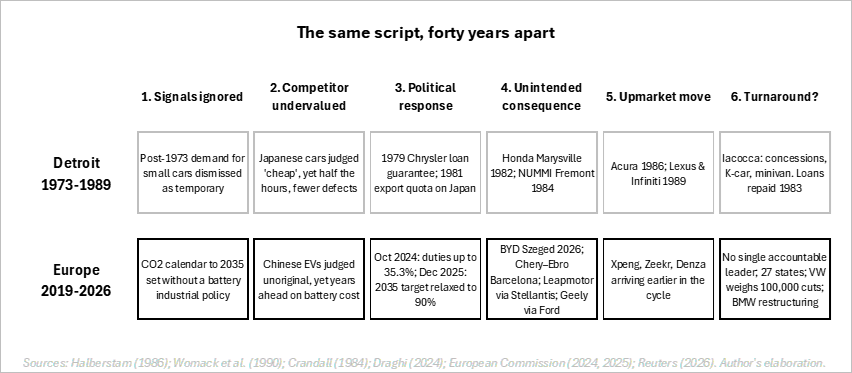
First, the incumbents ignored the market signals. After the 1973 oil embargo, American consumers began buying small, fuel-efficient cars in significant numbers. The Big Three3 dismissed them because these small cars meant small margins, and Detroit's economic model was built on large vehicles with large option lists. The Corolla, the Civic and the Datsun 510 were treated as a marginal phenomenon that would recede once petrol prices normalised. In fact, Pulitzer Prize winner David Halberstam (1986) documents in remarkable detail how Ford's and Nissan's leaderships read the same decade in opposite ways.
Second, they undervalued the competitor's product. Detroit's engineers and executives considered Japanese cars cheap in both senses of the word. The MIT International Motor Vehicle Programme4 would later demonstrate the opposite: Japanese plants were producing cars in roughly half the assembly hours, with a fraction of the defects, using a system of production that Womack, Jones and Roos (1990) called “lean production” based on the Toyota Production System (TPS) created by Taiichi Ohno and Kiichiro Toyoda. The competitor was not cheaper because it was worse, it was cheaper because it was better managed.
Third, the response was political before it was industrial. In 1981 Washington negotiated a “Voluntary Export Restraint” with Tokyo, capping Japanese car imports at 1.68 million units a year. The measure had two effects, neither of them intended. Japanese manufacturers built plants on American soil, beginning with Honda in Marysville, Ohio in 1982 and Toyota's joint venture with General Motors at Fremont in 1984, also known as NUMMI. And, with unit volumes capped, they moved upmarket to maximise revenue per car: Acura in 1986, Lexus and Infiniti in 1989. Prof. Robert Crandall (1984) estimated that the quota cost American consumers roughly $160,000 for every job it saved. By the time the German premium brands realised that a Japanese luxury sedan could out-build a Mercedes, and the American brands realised it could out-build a Cadillac, the protectionist window had closed and the competitor had used it to climb the value chain.
Fourth, and this is the part that is usually forgotten, the rescue came from inside the companies, not from the tariff. Iacocca obtained the loan guarantee, but the condition of the guarantee was concessions from the United Auto Workers5, from suppliers, from banks, and even from the executive suite (his own salary was set at one dollar). The UAW's president joined Chrysler's board. The K-car platform6, the minivan and a ruthless simplification of the product portfolio followed. Chrysler repaid the guaranteed loans in 1983, seven years ahead of schedule. Governmental protectionism bought time but the most important aspect was that leadership spent it well. Precisely that distinction between buying time and using it is the whole game changer.
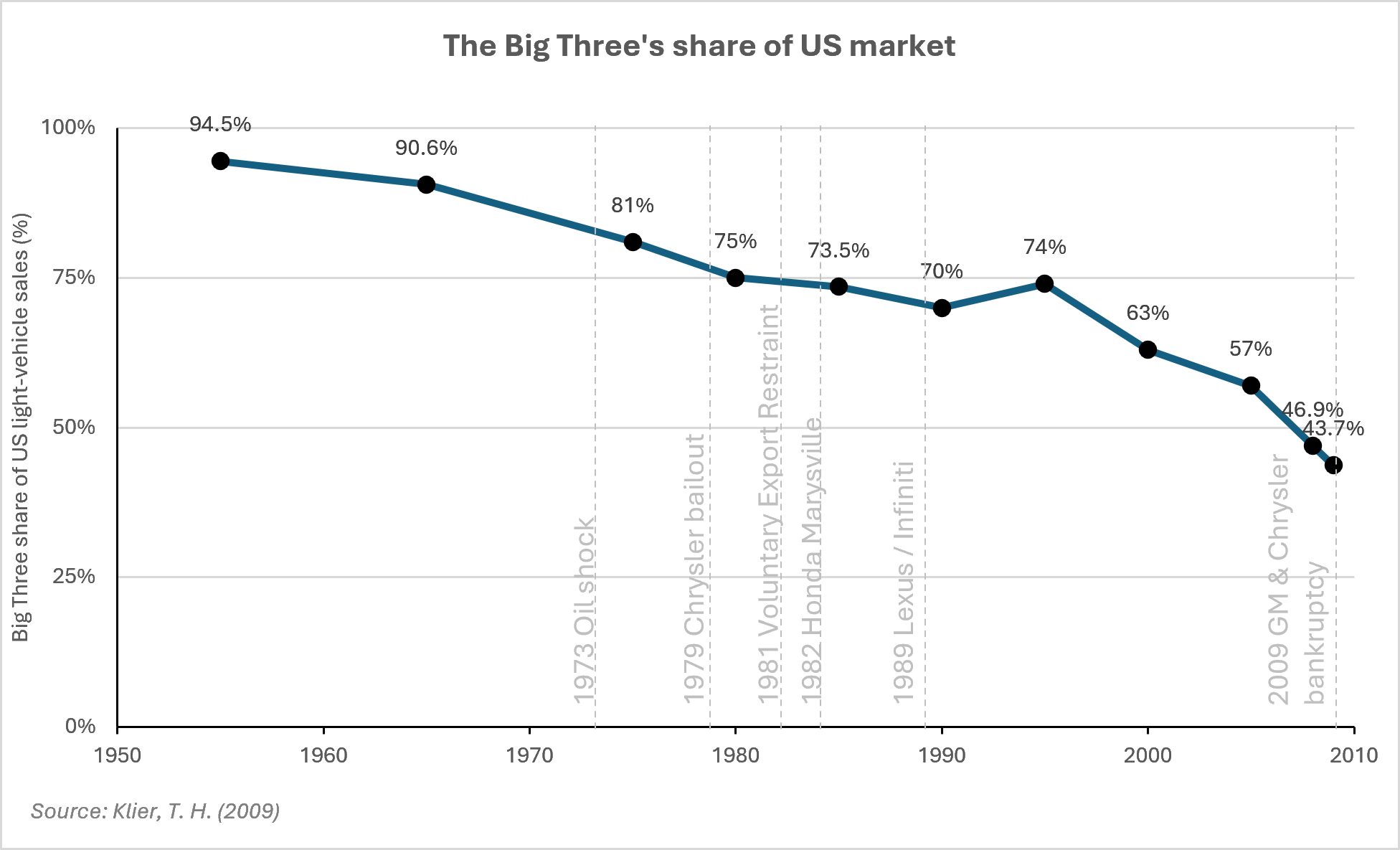
Even so, Detroit never fully recovered. The Big Three's share of their own domestic market fell from over 94% in the mid-1960s to well under half by 2008, when two of the three entered bankruptcy proceedings. The industry survived, reshaped and diminished, considering that the best achievable outcome is a controlled, late and painful adaptation.
Europe, 2019–2026: a crisis with no Industry leader
Now transpose the sequence to Europe:
The market signals were ignored, but with a European twist: the signals were regulatory before they were commercial. When the European Union fixed its CO2 trajectory for passenger cars, culminating in the 2023 decision to require zero tailpipe emissions from 2035, it did so without a corresponding industrial policy for batteries, raw materials or energy. Mario Draghi's report on European competitiveness (2024) stated that China had declared new-energy vehicles a strategic industry, invested an estimated €110–160 billion across the entire value chain by 2022, and secured access to the raw materials, while Europe regulated the demand side and left the supply side to the market. European manufacturers, meanwhile, spent the decade extracting virtuously incremental efficiency from diesel and petrol engines, which in some way resembled the same strategy Detroit had followed with its V8s.
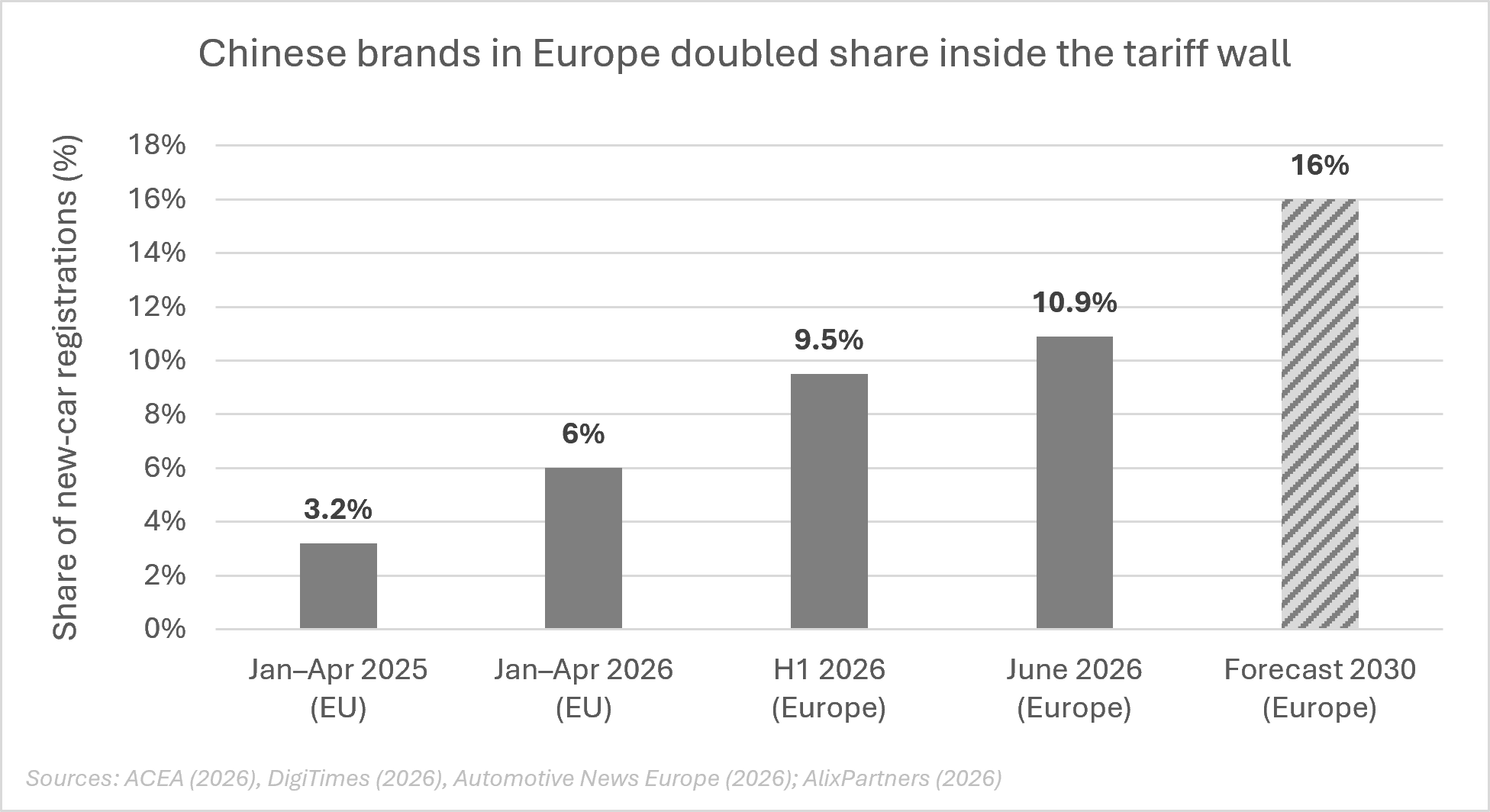
The competitor's product was undervalued. For years, Chinese cars were discussed in European boardrooms in the language Detroit once reserved for Japanese cars: unoriginal, low-quality, unsafe, unsuited to European taste. The reality is that BYD, Geely, Chery and SAIC arrived with vertically integrated battery supply chains, software-defined platforms and cost structures that European groups could not match. Chinese brands doubled their share of the EU market in the first four months of 2026 (from 3.2% to roughly 6%), reached 9.5% of Europe's new-car market in the first half of the year, and set a record 10.9% in June. AlixPartners (2026) now forecasts 16% by 2030, double the figure it published in 2024. Furthermore, in Germany, in the first half of 2026, Chinese brands sold almost as many electric cars as BMW.
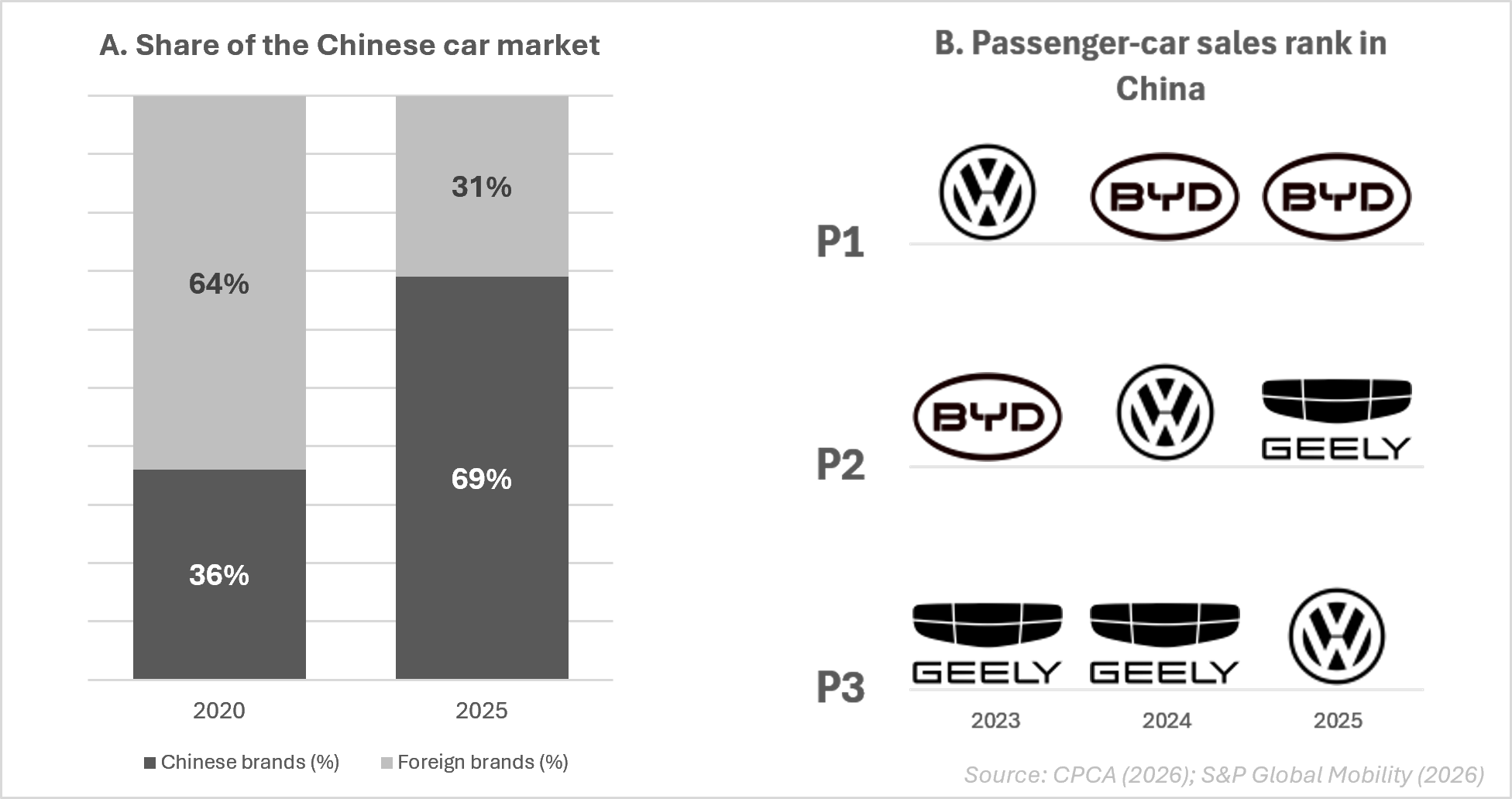
The losses began before the shocks, and they began in China. It is tempting to date Europe's crisis along to the COVID-19 pandemic, the energy shock, the Ukraine-Russia war, or the tariff war with the USA. The Bundesbank's (2025) own analysis clearly states that German export market shares have been contracting since 2017, and roughly three-quarters of the losses reflect deteriorating competitiveness rather than weak demand. German motor-vehicle production peaked in 2017 and by 2023 stood 15% below that level, with output of combustion passenger cars nearly halved. The decline predates every convenient biased explanation, and its epicentre is the protectionism that had financed German ambition for three decades. Local brands' share of the Chinese market rose from roughly 36% in 2020 to about 69% by 2025; German manufacturers' sales in China fell by around a quarter between 2021 and 2025; and Volkswagen, market leader in China for more than twenty-five years, was overtaken by BYD in 2024 and pushed to third place by Geely in 2025. Volkswagen's own China chief has conceded that younger Chinese buyers see the marque as their “parents' brand” as a kind of vintage nature of cars. The Big Three lost their home market to the challenger, but Europe is losing both its home market and its largest export market simultaneously, which adds an aspect that Detroit never experienced. So basically, the demand side of the German model has collapsed at both ends. Furthermore, the retreat is not confined exclusively to car manufacturing industry as in March 2026, BASF inaugurated its €8.7 billion Verbund complex in Zhanjiang while cutting capacity at Ludwigshafen, its home for 160 years.
The response has been political before industrial, and it could be producing certain unintended consequences. In October 2024 the European Union imposed countervailing duties of up to 35.3% on Chinese-built electric vehicles, on top of the standard 10% import tariff. The measure divided the member states, with Germany and Spain among those opposing it for reasons of retaliation risk and inward investment respectively. Its effects mirror 1981 with almost surgical precision. Chinese manufacturers pivoted to plug-in hybrids, which sat outside the tariff, while they accelerated localisation with BYD beginning production in Hungary in 2026, settling its European headquarters in Budapest, and is in discussions to take over idle Stellantis capacity across the old continent.
In the meantime, Chery, through its joint venture with Ebro, occupies the former Nissan site in Barcelona's Zona Franca; and Leapmotor sells through Stellantis' own network, whilst the upmarket move has begun with Xpeng, Zeekr and BYD's Denza (which are the Acura and Lexus of this story) arriving earlier in the cycle than their Japanese predecessors did in the American case.
And the regulatory retreat seems to arrive, late and defensively. In December 2025 the European Commission proposed replacing the 2035 zero-emission requirement with a 90% reduction target, allowing hybrids and combustion engines to remain on sale, with the residual 10% offset by official carbon bonds or sustainable fuels. Whatever the merits of the flexibility, its timing is the point, as Europe first imposed the most demanding decarbonisation calendar in the world, then relaxed it once the domestic industry proved unable to meet it, thereby combining the costs of rigidity with the loss of credibility that accompanies reversal. Detroit lobbied for years against fuel-efficiency standards; years later, Europe introduced them, and when the markets began to invest in other sectors, it started to revise its own standards.
The consequences are already clear, as Volkswagen closed its Dresden plant in 2025, the first closure in its history, whilst Audi has also closed its Brussels factory and its Neckarsulm plant is under threat. In July 2026 the Volkswagen supervisory board met to consider a restructuring that could eliminate up to 100,000 jobs and close four German plants, after the group's margins halved between 2021 and 2025 and its German factories were forecast to run at 81% of capacity, falling toward 73% by the end of the decade. The head of Germany's automotive association has said openly that further plant closures are inevitable, citing energy costs, labour costs and bureaucracy. The sector supports around 13.8 million jobs and more than 7% of EU GDP.
Regulation as planning: the Hayekian objection
There is a deeper way to read Europe's regulatory approach, and it takes us to a classic debate in political economy. On top of an initial environmental objective, the EU prescribed, with legal force, the technology, the calendar and the annual quantities by which a continental industry should transform itself, with fleet-wide CO2 targets per manufacturer per year, financial penalties of €95 per gram per vehicle for deviation, and, from 2035, a de facto mandate for a single propulsion technology alternative. Whatever one calls this, it is more than framework regulation; it is, in effect, a production plan, administered from the centre, for an industry this centre does not own.
In “The Use of Knowledge in Society” (1945) Hayek7 argued that the knowledge required for economic coordination (costs, preferences, local conditions and technological possibility) is dispersed among millions of actors and cannot be aggregated by a planning authority, which is why administrative targets systematically diverge from reality and must be corrected by decree, late, after the damage is visible. Years before, Mises8 (1920) stated that without market prices, the planner cannot calculate at all. The socialist economies that collapsed between 1989 and 1991 failed, as Kornai9 (1992) documented, mainly because targets replaced prices as the coordinating mechanism, and because loss-making producers were kept alive by what he called the “soft budget constraint”.
I do not claim that the European Union is strictly a socialist economy. Firms remain privately owned, prices remain generally free, and most importantly, the consumer still has the freedom to choose. However, the CO2 regulation reproduces, to a certain extent, the informational structure of central planning as it substitutes an administrative target for the market's discovery of the pace and mix of decarbonisation, and therefore inherits central planning's characteristic failure mode. The December 2025 reversal is the proof, as the “planner” discovered, through plant closures and margin collapse what a price mechanism (a carbon price applied neutrally across technologies, for instance) would have signalled years earlier and continuously, without any type of intervention. The innovative Swedish firm Northvolt, the battery champion sustained by public and quasi-public capital until its bankruptcy in March 2025, is a clean illustration of the soft budget constraint as Kornai could have asked for. Economies do not need to be socialist to fail in socialist ways, they just need to attempt to plan what they would never be able to know.
Why the sequel is harder than the original
If the diagnosis is the same, could the European scenario be worse than the American? Four structural differences.
First, Detroit had one sovereign while Europe has twenty-seven and a Commission ruling on top. Iacocca negotiated with one Congress, one Treasury and one union. A European turnaround requires alignment between Brussels, Berlin, Paris, Rome, Madrid, and so on, each with different exposure to China, different labour laws and different electoral calendars and interests. The tariff vote itself demonstrated that the European Union cannot even agree on the diagnosis, let alone the treatment.
Second, Detroit could restructure and Europe can only negotiate (and Germany is the extreme case). Chrysler's rescue was conditional on concessions extracted from every stakeholder within months. The UAW accepted wage freezes and deferrals; its president, Douglas Fraser, joined Chrysler's board in 1980, an exceptional, temporary arrangement, granted in exchange for sacrifice, in a system where labour otherwise would have had no seat in governance at all.
Germany inverts that architecture, and Germany is Europe's dominant manufacturer, so its architecture is Europe's. The model was forged deliberately with Erhard's10 1948 liberalisation that created the local market economy post-Nazi era. The decades that followed wrapped it in a protective structure (co-determination in the boardroom, a bank-based financial system with a large state-owned segment channelling credit to exporters), an education system calibrated to their needs, and a foreign policy subordinated to their energy costs (Russian gas being the terminal example). That armour won the export battles of half a century, but an architecture built to protect existing champions is, by construction, an architecture that suppresses Schumpeterian “creative destruction” mainly due to favourable flow of capital, talent and political advantage to the incumbents of the hegemonic and mature technological wave and not the entrants of the next one.
Germany’s central lock is in the “Co-determination Act” (Federal Republic of Germany, 1976), which stipulates that employee representatives hold half of the seats on the supervisory board (Aufsichtsrat) of every large company. This body of non-executives appoints and dismisses the executive board and approves all strategic decisions. At Volkswagen, a company-specific statute goes even further. “The Volkswagen Act” of 1960 grants the State of Lower Saxony, which holds roughly 20% of voting rights, a blocking minority, and requires a two-thirds supervisory-board majority for decisions on establishing or relocating production sites, which means that the labour bench and the regional government together hold a structural veto over any plant closure. The European Commission itself recognised the protectionist character of this construction when it litigated against the Volkswagen Act for the better part of a decade, and the European Court of Justice struck down parts of it in 2007 (Case C-112/05), yet the blocking-minority threshold survived in amended form (confirmed in Case C-95/12). The law written to shield Volkswagen from hostile capital in 1960 now shields it from its own restructuring, therefore could represent a continuity risk for the company.
Volkswagen’s current replanning (capacity cuts and reshaping of the proportion that the group is needing), would, in the Detroit's system, have been decided just by one board in one quarter, while in Germany has been under discussion, in various forms, since 2024, mediated between the executive board, IG Metall11, the works councils and the government of Lower Saxony, each holding formal veto points inside the company's own governance. Iacocca negotiated with the union, while a German CEO negotiates under it. This is evidence that a governance system designed to make change consensual, necessarily makes it slow, and that against a competitor operating at Chinese speed, slow and consensual may be indistinguishable from paralysis.
Third, Japan exported a product and China exported an entire industrial system. Japan's advantage in 1980 was manufacturing excellence in a defined segment. China's advantage in 2026 is simultaneous leadership in batteries, electronics, software, raw materials and manufacturing scale, backed by state capital and, increasingly, by European factories. Europe's attempt to build a domestic battery champion ended with Northvolt's bankruptcy in March 2025. The gap is broader, deeper and less recoverable than operational improvement alone.
And fourth, Detroit had one Lee Iacocca and Europe requires wide consensus. The academic literature on corporate turnaround consistently finds that recovery requires a visible leader with the authority to act, a credible sense of urgency, and the willingness to be unpopular for a period (Slatter & Lovett, 1999; Kotter, 1996). Lee Iacocca was all three at the same time. Furthermore, he was also a sales-oriented businessman who understood what the customer wanted before even the customer did. On the other hand, Europe's automotive leadership is collective, rotational and consensual. Carlos Tavares12, the closest recent approximation to a turnaround executive in the European industry, left Stellantis in December 2024 presumably after conflict with the board and the brands' national constituencies. Whatever one thinks of his methods, his departure illustrates my thesis that the European system does not produce, and does not tolerate, a new Lee Iacocca. The conditions that made Iacocca possible and effective in the USA are absent in the EU by design.
What Europe would need instead
Even if we step back from the tariff schedule and the plant-by-plant negotiations, the deepest failure comes into focus. A tariff against a superior product at a lower price could be a barrier erected against innovation itself rather than a trade protection instrument. As extensively mentioned in my articles, Schumpeter (1942) called “creative destruction” the process whereon modern prosperity depends, which is essentially the incessant replacement of old structures by new and more innovative ones, and Christensen (1997) explained the mechanism by which old market players fail to survive it, as they underestimate the new entrants, innovate just for their existing customers and metrics (“sustaining innovation”), and discover the challenger in their core market only when the cost structure that put it there is already jeopardising their comfortable market. Europe's response to the Chinese entrant has been to suppress the process rather than master the mechanism, taxing the vulnerability instead of diagnosing what Europe was missing (battery chemistry, software platforms, energy cost, capital depth, motivated talent) and creating the conditions for it to emerge at home. Building a wall through protectionism gives an industry a false sense of comfort rather than a proper ground for innovation.
The correct action towards a competitiveness gap is rarely a tariff or a subsidy, whether from Brussels, Berlin or a regional government. State-directed investment tends to flow to the incumbents of the consolidated technological wave, and it is Kornai's soft budget constraint in modern facet. What innovation requires is a playground with technology-neutral rules, affordable energy, deep and risk-tolerant capital markets, labour mobility, fast permitting, and the freedom to fail. Schumpeter's innovation process needs to be permitted, and not planned from above.
One may oppose the existence of these subsidies and still recognise that companies must compete in the world as it is, not the world as it should be. The support programmes already exist and for a European manufacturer to refuse them alone, while strong rivals economies draw freely on their own governments, would be to pay the price of principle without buying any of its benefits. Therefore, the pragmatic course for European manufacturers is somehow twofold: take the instruments that exist, as well as spend the political capital they confer on the aspects that actually makes them more competitive. Concretely, that means pressing Brussels for regulation of ends rather than means, for radical simplification of the compliance burden, and for the labour and capital-market reforms that would let firms restructure at the speed the market now demands in this century. The message to the European bureaucracy should be the one Iacocca delivered to Congress: give us the bridge, then get out of the way, and later the market will judge our results.
This is exactly where leadership emphasizes the argument where petitioner matters as much as the petition. Regulators do not dismantle their own rulebooks in response to position papers from trade associations; they should respond to credible, visible leadership that speaks with one voice and puts its own concessions on the table, as Iacocca did. If Europe's institutional design cannot produce a single Iacocca (and I have described it could not) then the functional equivalent must be collective through a coalition of the industry's leaders, incumbents and challengers together, willing to trade protection for freedom and to commit publicly to the responsibility that freedom implies. Detroit's rescue required one man with authority and Europe's would require a handful with unanimity and with the same determination. The second is much harder to reach, which is rather the point of this article.
Beyond that political framework, three conditions remain indispensable:
1.- Regulation of outcomes, not technologies. The EU 2035 mandate picked a winner technology, while the December 2025 retreat un-picked it, so both moves destroyed central planning credibility. A stable, technology-neutral decarbonisation constraint would let the market discover the mix, the pace and the survivors with much less distortion.
2.- A market that permits failure and consolidation. Detroit's adaptation was possible because capital, labour and factories could be reallocated. Europe has eleven volume brands within two groups alone. Overcapacity will be resolved either by managed consolidation or by Chinese acquisition of idle plants, so the choice is not whether, but who will.
3.- Learning from the competitor rather than underestimating it. General Motors learned lean production not from tariffs but from Fremont’s joint factory, where Toyota ran a former GM plant with GM workers and doubled its productivity. The European equivalent is already happening as Chinese groups are building in Hungary and Spain, partnering with Stellantis, Renault, Volkswagen or Ford, while supplying batteries to every European premium brand. The question is whether Europe treats these as Trojan horses or as the Fremont plant of its generation.
FINDINGS for executives outside the automotive sector
The pattern is not specific to cars. Any incumbent facing a lower-cost, faster-learning entrant should recognise it.
First, take the "cheap" competitor seriously the moment it appears at the bottom of your market. Christensen (1997) showed that disruptive entrants are dismissed precisely because their first products are inferior on the metrics incumbents value. By the time they meet you in your core segment, the cost structure that allows them to do so is already built.
Additionally, distinguish between buying time and using it. Protection, subsidies and regulatory relief are legitimate tools, but they are only valuable if the organisation uses the interval to change its cost base, its product logic and its innovation culture. A tariff that funds inertia is more expensive than no tariff at all.
Do not confuse regulatory compliance with strategy. European manufacturers spent a decade optimising for the CO2 rulebook rather than focusing on the customer needs and wishes. So the rulebook changed as the customer had been asking for a different product all along.
Finally, turnarounds must be strongly led and not just co-administered with dispersed responsibilities. If your governance model cannot produce a single accountable executive with authority to act within months, you do not have a turnaround plan, you just have a negotiation playground. Furthermore, where one leader is structurally impossible, the substitute is not a committee but a coalition, hence a small group of people with unanimity of purpose, public commitments, and skin in the game.
CONCLUSION
Detroit's story ended with pragmatic survival, diminished but real, because a market economy allowed failure, a political system allowed concession, and one executive was permitted to lead. Europe is running the same script in a more rigid, more expensive, more fragmented setting, against a competitor that is larger, faster and already inside the built walls. The tariffs were supposed to be the pause before the turnaround. Eighteen months on, the pause is being used by the challenger, not by the incumbent.
There is no European Lee Iacocca, and I have argued that, under current conditions, there cannot be one. But the title is a diagnosis, not merely the choice of an academic-practitioner who has watched this industry for decades. What one man did in Detroit, a determined coalition of Europe's industrial leaders could still do here. Whether that coalition forms, or whether Europe keeps raising walls around an industry it has not yet decided to fix, is the scenario now unfolding, quarter after quarter, at extraordinary speed.
REFERENCES
AlixPartners. (2026). Global Automotive Outlook 2026. Summary of European forecasts reported in Automar, “Chinese Car Brands: 16% of Europe's Market Share by 2030,” August 2026. https://automar.pt/en/blog/marcas-chinesas-quota-mercado-europa-2030
Automotive News Europe. (2026). Chinese brands hit record market share in Europe in June. 24 July 2026. https://www.autonews.com/retail/sales/ane-europe-chinese-sales-june-2026-0721/
BASF SE. (2026). A flagship for chemical production: BASF inaugurates world-scale Verbund site in China. Press release P045/26e, 26 March 2026. https://www.basf.com/global/en/media/news-releases/2026/03/p-26-045
Bertelsmann Stiftung / BST Europe. (2025). Draghi Report and EV Tariffs: Why a Stop Now Would Send the Wrong Signal. 23 May 2025. https://bst-europe.eu/economy-security-trade/draghi-report-and-ev-tariffs-why-a-stop-now-would-send-the-wrong-signal/
Bloomberg. (2026). Europe's Car Industry Faces Dramatic Crisis, German Lobby Says. 8 July 2026. https://www.bloomberg.com/news/articles/2026-07-08/europe-s-car-industry-faces-dramatic-crisis-german-lobby-says
China Passenger Car Association data (2026). Volkswagen drops to third in China sales as fast-growing Geely Auto overtakes. 12 January 2026, Reuters
Christensen, C. M. (1997). The Innovator's Dilemma: When New Technologies Cause Great Firms to Fail. Harvard Business School Press.
Crandall, R. W. (1984). Import quotas and the automobile industry: The costs of protectionism. The Brookings Review, 2(4), 8–16.
Deutsche Bundesbank. (2024). Weakness in the German automotive industry continues. Monthly Report. https://www.bundesbank.de/en/tasks/topics/monthly-report-weakness-in-the-german-automotive-industry-continues-945866
Deutsche Bundesbank. (2025). What's behind the sustained decline in German export market shares? Monthly Report, July 2025. https://www.bundesbank.de/en/tasks/topics/what-s-behind-the-sustained-decline-in-german-export-market-shares--961244
DigiTimes. (2026). Chinese automakers push Europe share to 9% as trade fight intensifies, 10 August 2026. https://www.digitimes.com/news/a20260810PD216/automakers-europe-market-share-2026-expansion.html
Draghi, M. (2024). The Future of European Competitiveness. Part B: In-depth Analysis and Recommendations (Chapter on Automotive). European Commission. https://commission.europa.eu/topics/eu-competitiveness/draghi-report_en
El Informe K. (2026). Alemania se hunde [video]. YouTube. https://youtu.be/cjt3QBZXtGw
European Automobile Manufacturers' Association (ACEA). (2026). New car registrations, January–April 2026. Reported in Euronews, Chinese carmakers double EU market share as EVs drive sales growth, 27 May 2026. https://www.euronews.com/business/2026/05/27/chinese-carmakers-double-eu-market-share-as-evs-drive-sales-growth
European Commission. (2024). Commission Implementing Regulation (EU) 2024/2754 imposing a definitive countervailing duty on imports of new battery electric vehicles designed for the transport of persons originating in the People's Republic of China. Official Journal of the European Union, 29 October 2024.
European Commission. (2025). Automotive Package: proposal to amend Regulation (EU) 2019/631 on CO2 emission performance standards for new passenger cars and vans. 16 December 2025.
European Commission. (2025). Industrial Action Plan for the European Automotive Sector. COM(2025) 95 final, 5 March 2025.
European Court of Justice. (2007). Commission of the European Communities v Federal Republic of Germany (Volkswagen Act), Case C-112/05, judgment of 23 October 2007; and (2013) Case C-95/12, judgment of 22 October 2013.
Federal Republic of Germany (1960) Gesetz über die Überführung der Anteilsrechte an der Volkswagenwerk GmbH (Volkswagen Act), 21 July 1960, as amended.
Federal Republic of Germany. (1976). Gesetz über die Mitbestimmung der Arbeitnehmer (Co-determination Act), 4 May 1976.
Fèvre, P. L. (2025). Factores de éxito de una empresa creada para el lanzamiento de un producto innovador y disruptivo en un mercado consolidado (Thesis DBA). Madrid: Universidad Pontificia Comillas.
Forbes. (2025). Winton, N., European Automakers Will Struggle In 2026 As Car Buyers Win, 29 December 2025. https://www.forbes.com/sites/neilwinton/2025/12/29/european-automakers-will-struggle-in-2026-as-car-buyers-win/
Halberstam, D. (1986). The Reckoning. William Morrow.
Hayek, F. A. (1944). The road to serfdom. Routledge.
Hayek, F. A. (1945). The use of knowledge in society. American Economic Review, 35(4), 519–530.
Iacocca, L., & Novak, W. (1984). Iacocca: An Autobiography. Bantam Books.
Klier, T. H. (2009). From tail fins to hybrids: How Detroit lost its dominance of the U.S. auto market. Economic Perspectives, 33(2), Federal Reserve Bank of Chicago
Kornai, J. (1992). The Socialist System: The Political Economy of Communism. Princeton University Press.
Kotter, J. P. (1996). Leading Change. Harvard Business School Press.
Mises, L. von (1920). Economic Calculation in the Socialist Commonwealth, Archive for Social Science and Social Policy, 47
Porter, M. E. (1990). The Competitive Advantage of Nations. Free Press.
Reuters. (2026). BYD Hungary plant to start production in late 2026, executive says, 9 June 2026. https://www.globalbankingandfinance.com/byd-hungary-plant-start-production-late-2026-executive/
Reuters. (2026). Volkswagen stakeholders meet to decide future of creaking auto giant, 9 July 2026. https://www.globalbankingandfinance.com/volkswagen-stakeholders-meet-decide-future-creaking-auto/
Schmidt Automotive Research. (2026). European Electric Car Market Report. Reported in E&T Magazine, Chinese EVs set for record 14.2% share of European market, 10 August 2026. https://eandt.theiet.org/2026/08/10/chinese-ev-sales-hit-record-high-europe-14-2
Schumpeter, J. A. (1942). Capitalism, Socialism and Democracy. Harper & Brothers.
Slatter, S., & Lovett, D. (1999). Corporate Turnaround: Managing Companies in Distress. Penguin Business.
S&P Global Mobility (2026). Germany's big carmakers used to lead the race in China. Now they're "for the parents." 21 April 2026. https://www.globalbankingandfinance.com/germanys-big-carmakers-used-lead-race-china-theyre-parents/
United States Congress. (1979). Chrysler Corporation Loan Guarantee Act of 1979. Public Law 96-185, 7 January 1980.
Womack, J. P., Jones, D. T., & Roos, D. (1990). The Machine That Changed the World: The Story of Lean Production. Rawson Associates / MIT International Motor Vehicle Programme
Philippe Fèvre (plfevre@comillas.edu) earned his DBA cum laude from Universidad Pontificia Comillas. He holds postgraduate qualifications from Chicago Booth, IE Business School, MIT as well as Universidad Pontificia Comillas. A senior executive and strategic advisor with over 25 years of international experience. His academic research interests include SME leadership, disruptive entrepreneurship, and digital transformation.