In September 2026, one in seven French petrol stations ran out of at least one fuel, and millions of drivers were paying record prices for diesel across Europe. This situation is characterised by two overlapping scenarios of scarcity; on the one hand, a retail-level crisis caused, to a large extent, by the introduction of a cap on fuel prices, and, on the other hand, a continent-wide diesel shortage triggered both by the closure of the Strait of Hormuz and by Ukraine’s campaign of attacks on Russian refineries, as well as the exodus of Asian exporters. This article argues that these crises affected a refining system already weakened, in part, by regulatory interference in the market, causing Europe to lose a fifth of its refining capacity since 2009, and France around 40%. The EU’s decision to end the sale of combustion-engine cars by 2035 can be interpreted as centralised planning, with the well-known impact on market information described by Hayek, as well as the ‘Dynamics of Scarcity’1 described by Kornai. Although the measures imposed by Europe were aimed at car manufacturers, the plan was extended to all suppliers in this industry; and according to IAS2 16 and 36 under the IFRS3 accounting standard, such a product deadline would shorten its useful life, leading to impairment losses and a reduction in depreciation for each future maintenance cycle. It could therefore be argued that, despite the current record profit margins in the oil refining industry, investment in the sector has not picked up. This effect can also be observed in another automotive industry supplier, such as the steel industry, which provides an example that reinforces the argument sought to be developed in this article.
From the assembly line to the petrol station
The European automotive crisis, which I previously analysed in my article “There Is No European Lee Iacocca” (Fèvre, 2026), is far beyond to its factories and assembly lines. The automotive industry sits at the apex of a vast pyramid of suppliers (steel, components, semiconductors, glass, tyres and the refineries that supply fuel for the final product), and each level has had to readjust its future prospects in line with those set out by Brussels for the automotive sector. In fact, this readjustment has been most severe where capital requirements are greatest. For example, a component manufacturer might be able to adjust its workforce within less than a year to accommodate a new level of demand, but a refinery represents billions of euros in assets built to operate for decades, which must be maintained and upgraded to remain competitive. Of all the possible adjustments, the one whose decline the consumers perceives at the petrol pump, is precisely that of the refineries, and that is the subject of this article.
Last September, around 15% of France’s approximately 10,000 petrol stations reported a shortage of at least one type of fuel, and diesel prices hit a record high, exceeding €2.39 per litre (Woodward, 2026; Business Today, 2026). The official explanation centred on the war in the Strait of Hormuz and Ukrainian drones striking Russian refineries, which led the French government to impose price controls, triggering massive panic-driven buying. However, the various crises of 2026 affected a refining system that had been in decline for fifteen years and which, in part, had been deliberately allowed to deteriorate.
What is revealed by the fuel pump and what remains hidden
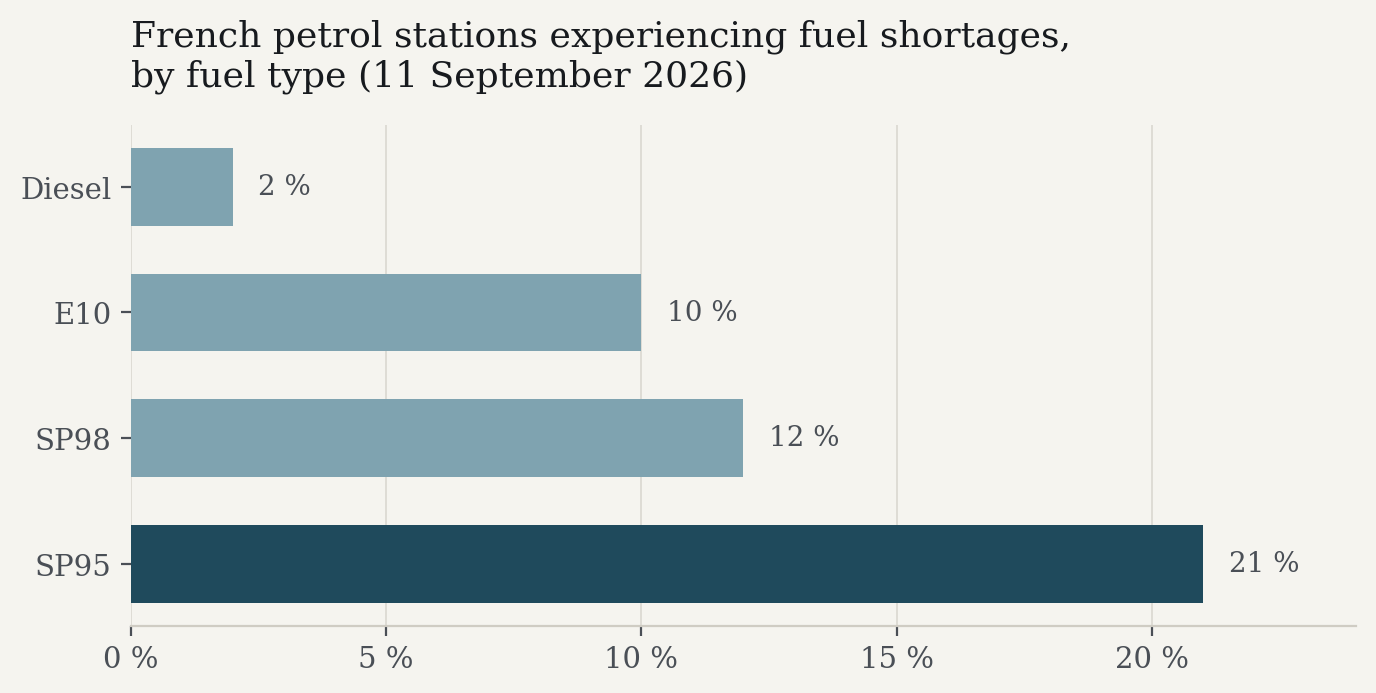
At petrol stations. The French public has faced the crisis in the form of shortages of both petrol and diesel. On 11th September, 21% of petrol stations had run out of SP95, 12% of SP98 and 10% of E10, compared with 2% for diesel (Enerzine, 2026). The proportion of petrol stations experiencing difficulties rose from 11% on 17th September to 15% on 20th September, and even this figure underestimates the problem, as the Government only counts a station as experiencing difficulties when it has run out of all types of petrol or diesel (Rallo, 2026; Roole, 2026). As of 21st September, 91% of the petrol stations experiencing difficulties belonged to TotalEnergies4, whilst the Government insisted that strategic reserves were full and refineries were operating at full capacity (L’EnerGeek, 2026). Consequently, there is an overlap between, on the one hand, a retail-level shortage concentrated in areas where prices remained low, and, on the other hand, a nationwide diesel shortage, which is less visible at petrol stations but has a greater impact on prices.
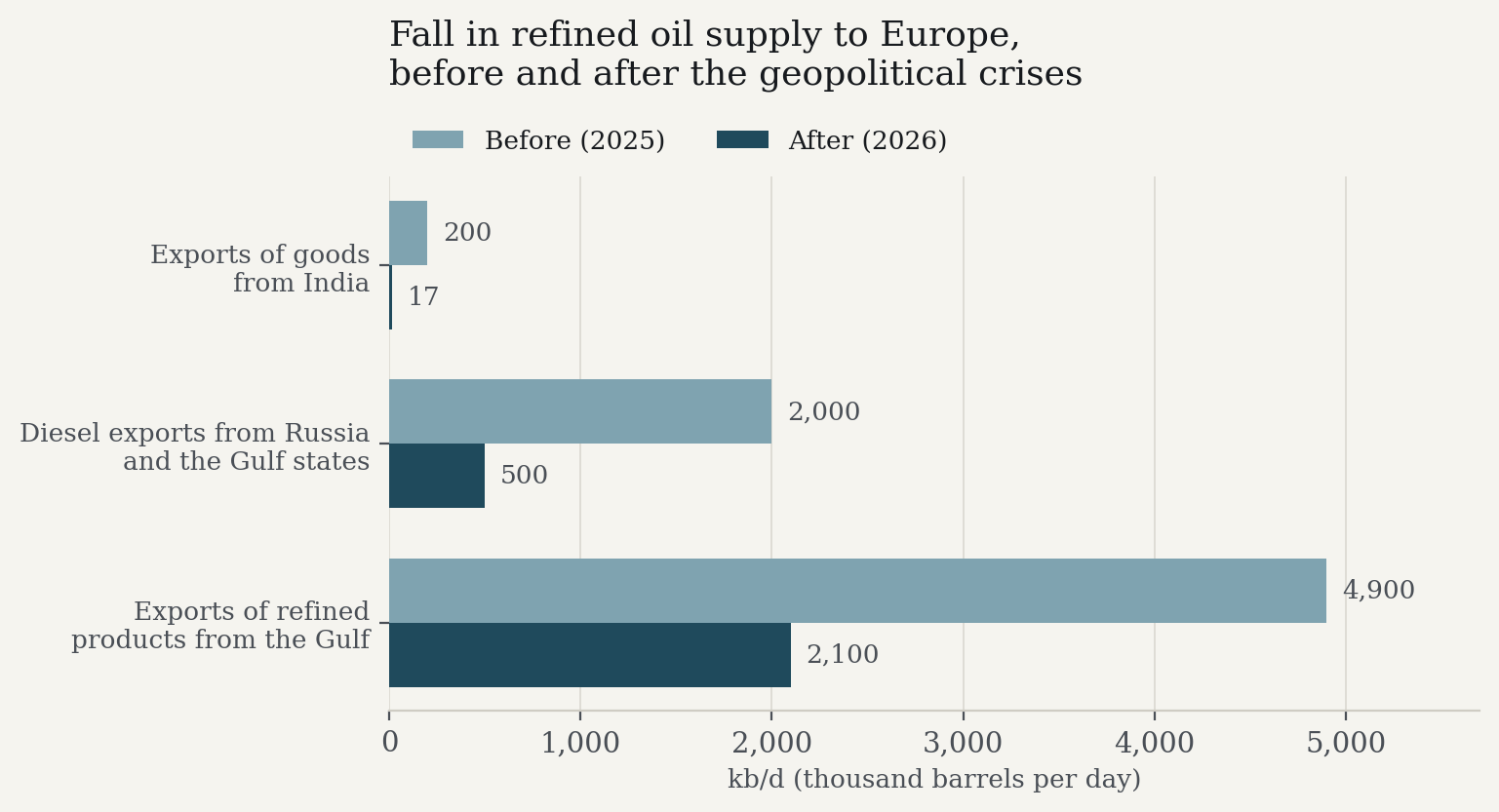
The price. The diesel shortage is the most serious due to its widespread impact on the economy, as it is the fuel most widely used in freight transport and agriculture, which leads to a direct impact on the CPI within a short period of time5. On 23rd September, the premium of European diesel over Brent exceeded 95 USD per barrel, the highest level recorded since 2011 (Bloomberg, 2026). By early April, wholesale diesel prices in Europe had already doubled, with stocks covering 71 days’ consumption across the OECD in Europe, but only around one month in Spain and Portugal and 20 days in the United Kingdom (Devaux, 2026). In September, Europe’s diesel imports fell to around one million barrels a day, the lowest level ever recorded in September (Slav, 2026), and even the petrol buffer is shrinking, with exports having fallen from 1.9 to 1.63 million barrels a day over the course of a year (Harvey, 2026). As Rallo (2026) points out, the bottleneck has shifted from crude oil to refined products because combined diesel exports from Russia and the Gulf have fallen by three-quarters, from around two million barrels a day in 2025 to half a million (VisualEconomik, 2026).
The Gulf. Since the US and Israeli attacks on Iran in late February 2026, the Strait of Hormuz has remained closed to normal maritime traffic for most of the year. Daily transits fell to around five vessels in early March, compared with a pre-war average of over 90 (Oxford Institute for Energy Studies, 2026), and by mid-October, with negotiations at a standstill, the IMF’s PortWatch recorded four transits on 4th October, compared with a pre-crisis baseline of around 85 per day (Carra Globe, 2026; Straits.live, 2026). Europe’s direct exposure appeared modest, but around 90% of its imports of goods through the strait consisted of diesel and aviation fuel, and Gulf exports of both products to the EU fell by 70% in March alone. Europe had already entered a supply crisis whilst facing pre-existing shortages, with high diesel margins and refined product stocks below their five-year average, and the war eliminated the region that had replaced Russia following the EU embargo imposed due to the conflicts with Ukraine. Between 2022 and 2025, Europe had increased its imports of products from the Gulf, but in March the war led to a reduction in exports from 4.9 to 2.1 million barrels per day (Fattouh and Economou, 2026). In August, net diesel exports from the Middle East stood at approximately a quarter of pre-war levels (IRU, 2026).
Why in September and not in March? The strait was closed in March, but petrol stations did not run out of fuel until September. Rallo (2026) explains that all the alternative routes were closed one after the other. Saudi Arabia diverted some 5.5 million barrels a day via its East-West pipeline to the Red Sea until drone attacks from Iraq forced its closure, whilst Houthi activity made the southern exit from the Red Sea dangerous. According to the French Ministry of Finance, European refineries have had to seek alternative crude supplies just as transport costs were soaring, and Aramco has informed several of these refineries that some October shipments will not arrive.
Russia. Europe has not purchased Russian diesel directly since the embargo in February 2023. Russia supplied half of Europe’s diesel imports in 2022, a figure that fell to less than 1% in 2024 (US Energy Information Administration, 2025). Consequently, the attacks on Ukraine are harming Europe indirectly by reducing the global supply from which it used to source its diesel. The IEA6 estimates that, in the first eight months of 2026, a Russian refinery was attacked on average every three days and that Russian diesel production fell by almost 30% (International Energy Agency, 2026). Moscow banned diesel exports from 8th July (CNN, 2026) and, by mid-September, three of the six refineries producing half of Russia’s diesel were either closed or operating at approximately a quarter of their capacity (Geiger, 2026). Turkey and Brazil, which had absorbed at least half of Russia’s diesel shipments, were forced back onto the Atlantic market to compete with Europe, whilst the EU’s eighteenth round of sanctions closed off the route through which Russian crude oil was returning in the form of Indian or Turkish diesel (Katinas, 2026).
Asia. The third source of supply has also been cut off. China, one of the few countries with excess refining capacity, halted exports of refined products in March and suspended them again in October, whilst India’s exports of refined products to Europe fell from an average of 200,000 barrels per day in 2025 to 17,000 in March, as its refineries shifted their focus to Asian buyers (Fattouh and Economou, 2026; Slav, 2026).
The queues. France then suffered a third setback, and this time a self-inflicted one. TotalEnergies caps its retail prices at €1.99 per litre for petrol and €2.25 for diesel – between 20 and 30 cents below many of its competitors, and 90% of the supply issues recorded by the Government occur within its network (Woodward, 2026). Price controls began informally in February 2023 when President Macron asked the sector to make “a gesture” regarding fuel prices. This was repeated in September 2023 at the public request of the then Minister for the Economy, Bruno Le Maire, who ruled out official state intervention (Motor1, 2023; Reuters, 2023); however, it has been applied to some extent since March 2026. As is often the case in politics, the current minister, Roland Lescure, has attributed the shortages to this mechanism introduced by his predecessor (L’Automobiliste, 2026). In any case, it is this type of intervention that causes problems, setting a price below the market equilibrium level which attracts buyers faster than tanker lorries can restock, just as panic-driven demand reaches its peak7. On 10th October, one in six petrol stations was still reporting shortages, nine out of ten of which belonged to the TotalEnergies network (Skenta, 2026).
Fifteen years of contraction
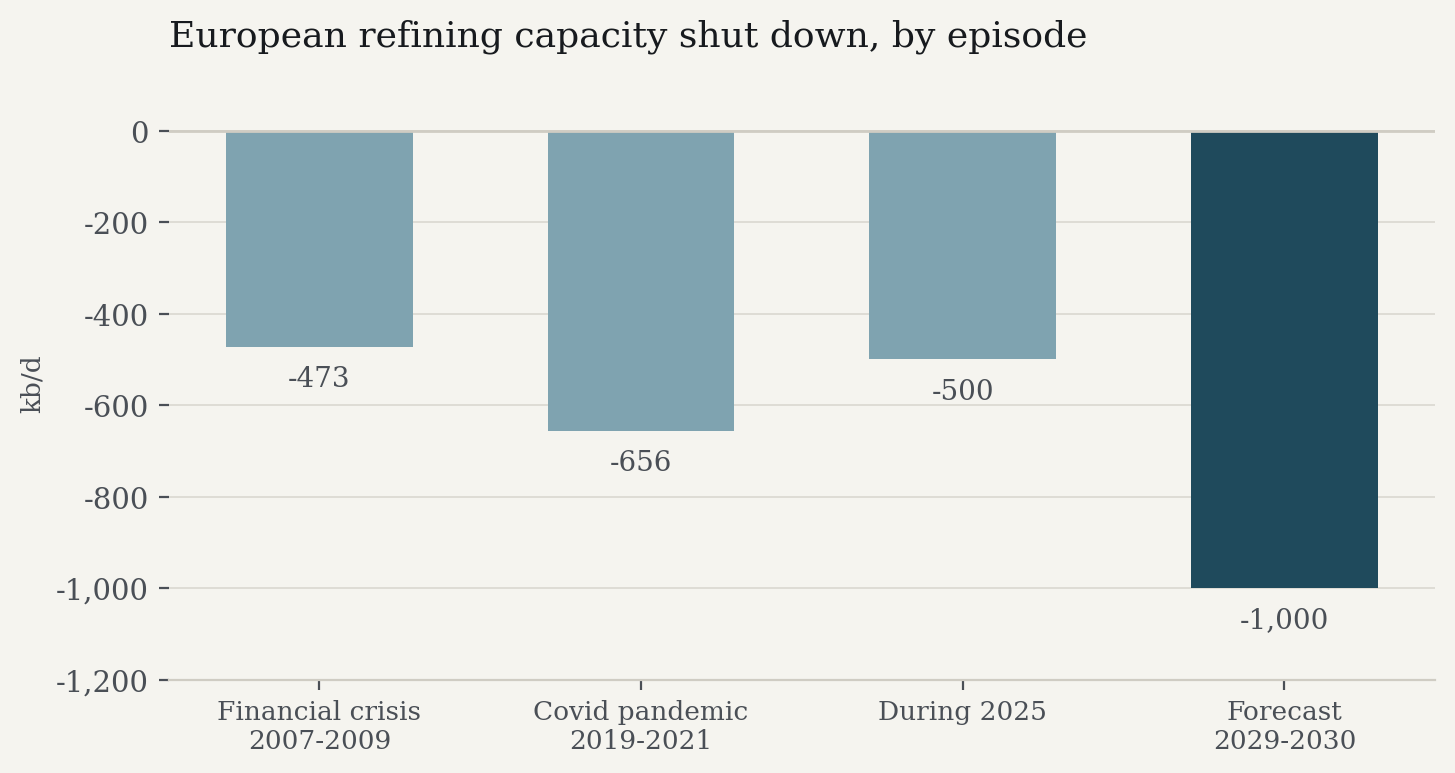
By the end of 2025, the EU, the UK, Norway and Switzerland had 72 conventional refineries with a primary capacity of 625.4 million tonnes per year, 167.6 million tonnes (approximately one-fifth) less than in 2009; FuelsEurope8 records 35 closures during that period (Pacheco, 2026). Of this decline in capacity between 2009 and 2035, in 2025 alone, capacity equivalent to some 500,000 barrels per day was shut down, including the Grangemouth refinery in Scotland, the Wesseling refinery in Germany, a third of the BP complex in Gelsenkirchen and, following the insolvency of its owner, the Lindsey refinery in England (Argus, 2025; Petro Online, 2026).
In any case, France is the most extreme example in the EU in terms of impact on volume, as between 2010 and 2017, French capacity fell at an annual rate of 4.2%, whilst domestic demand for oil fell by only 0.8% per year, which is approximately double the European closure rate (Ministry for Ecological Transition, 2018). The refineries at Flandres, Reichstett, Berre and Petit-Couronne, as well as the crude oil processing units at La Mède and Grandpuits, have closed down. In 2024, France imported 25.1 million cubic metres of diesel, 28% of which came from the Middle East (UFIP Énergies et Mobilités, 2025). Having lost Russia, its main supplier, in 2022, France replaced it with a region that has now also ceased to supply it following the conflicts in the Middle East.
Since 2000, Europe’s share of global refining capacity has fallen from 22% to 14%, whilst Asia’s has risen from 26% to 36%. In terms of volume, European capacity has fallen by 17% and Asian capacity has risen by 74% (Devaux, 2026). Europe now imports 35% of its diesel, and France 38%.
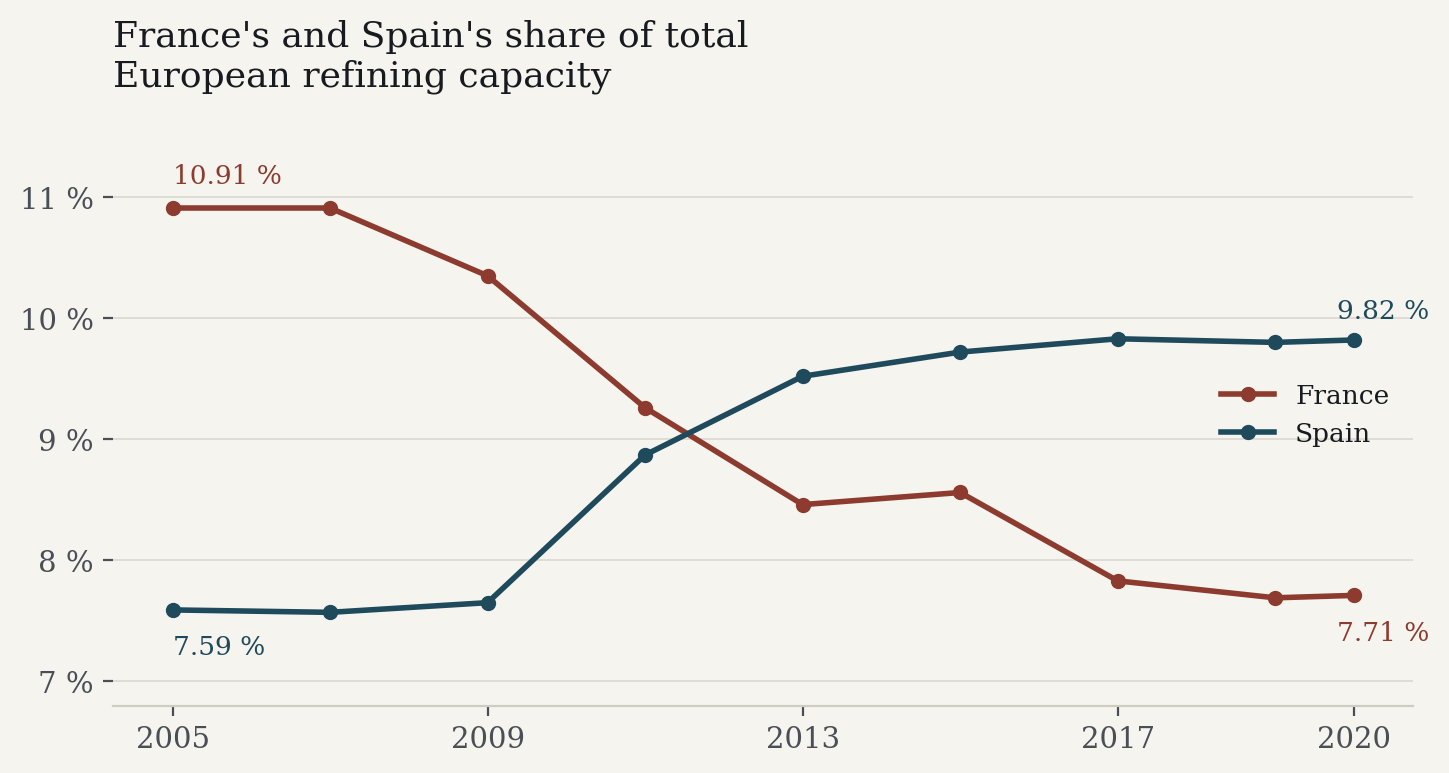
Interestingly, when comparing Spain’s capacity figures with those of their neighbour, France, the decline is uneven. Between 2005 and 2020, France’s share of total European capacity fell from 10.9% to 7.7%, whilst Spain’s rose from 7.6% to 9.8% (Klepikov and Klepikova, 2022).
In addition to all of the above, the near future is set to see even more closures, as forecast by S&P Global, with a reduction of almost one million barrels per day in the 2029–2030 period alone, more than double the 473,000 barrels per day that have already been shut down, and the IEA9 estimates that capacity at risk by 2030 will be between 1 and 1.5 million barrels per day (Norways, 2024).
Looking more closely at the details of these fluctuations in capacity, it can be seen that the variations differ across products. European refineries were largely configured for petrol, whilst three decades of “dieselization”, driven by various incentives, turned the continent into a structural importer of so-called light and medium distillates10. In 2025, the EU was still importing 3.2 million barrels per day of clean products, of which around 60% was diesel and jet fuel, whilst demand for petrol stood at 450,000 barrels per day above its 2019 level (Fattouh and Economou, 2026). Wood Mackenzie estimated that 45% of the world’s high-risk refineries were located in Europe in 2024 and 60% in 2025, citing carbon costs and the electrification of transport (Wood Mackenzie, 2024; DieselNet, 2025).
Refining is a joint production process, producing petrol, diesel, aviation fuel and heavier products in proportions that conversion units can only alter marginally. A refinery that closes because it can no longer find export markets for its petrol takes its diesel with it; consequently, by reducing the capacity to absorb a surplus of petrol, Europe exacerbated the diesel deficit it already faced (Harvey, 2026). Furthermore, demand remains strong, as in 2023 petroleum products continued to account for almost 98% of the energy used in European road transport (Fattouh and Economou, 2026).
Planning with a deadline
The decision to end the sale of new passenger cars with internal combustion engines by 2035 differs in nature from most environmental regulations. A carbon price, or an emissions cap calculated for the economy as a whole, specifies an outcome and leaves the means to achieve it to the discretion of producers and consumers. Regulation (EU) 2023/851 required a 100 per cent reduction in CO₂ emissions from new passenger cars and vans, and established battery-electric propulsion as the technology of the future, setting the date from which its competitors would be phased out (European Parliament and Council, 2023a). This is precisely what we might interpret as a kind of production plan defined by a central authority that determines which technology the economy will use and from when.
Hayek’s objection to this type of plan is that planners cannot possess the comprehensive knowledge required by such a complex plan with so many implications (Hayek, 1945). Whether a technology can sustain an entire market by 2035 depends on battery costs, the capacity of the electricity grid, raw materials, technology, consumers’ willingness to pay for that product and, furthermore, competition from China. All these factors were unknown when the regulations were drafted and have since evolved against Europe’s own interests, a fact that the regulators themselves are now acknowledging. Mario Draghi’s 2024 competitiveness report presented the automotive sector as an example of how the EU was implementing a climate policy without an industrial policy (Draghi, 2024), a point I have already outlined in a previous article. A year later, he stated that the targets for the automotive sector were based on assumptions that were no longer valid and called for a technology-neutral review (van Gaal, 2025). Three months later, the European Commission itself proposed scaling back the target to a 90% reduction.
The European Commission’s Directorate-General for Climate Action itself had spoken out against the change, emphasising in January 2025 the need to “continue to provide certainty for the market and investors”. The Commission gave in to pressure from Germany, six other Member States and the industry, and the European People’s Party’s draft proposal in Parliament would reduce the effective target to around 73% (Dahl, 2026). The revised proposal will also allow car manufacturers to offset residual emissions using low-carbon steel, synthetic fuels and biofuels. The plan, which previously ignored supplier industries, now quite rightly incorporates them as compliance tools. As of mid-October 206, nothing has yet been decided, and Parliament’s Transport Committee has postponed its vote (Electrive, 2026).
Due to the impact on petrol stations that has been observed this year, those responsible for planning have begun to analyse the capacity of oil companies and their refineries. As early as March 2026, the Commission called on Member States to refrain from adopting measures that might discourage production at EU refineries (Fattouh and Economou, 2026), a sound request that its own regulatory framework had ignored for five years. On 6th October, the President of the European Commission, Ursula von der Leyen, announced a strategic dialogue on European refineries, chaired by the Commissioners for Energy and Defence, to safeguard supply, albeit “also for defence purposes” (Pacheco, 2026). This is the same approach used with car manufacturers in 2025 (Dahl, 2026), as first the timeframe was set, then the planner convened the stakeholders, and the industry responded by requesting what the plan had denied it, namely, stable policies and greater certainty regarding the necessary investments (FuelsEurope, 2026).
On the other hand, Michael Bloss, a German MEP from the Green Party, argues that the closures were business decisions driven by falling demand and slim profit margins, and that blaming climate policy is to put the cart before the horse, as the real mistake was to maintain emergency reserves primarily in crude oil rather than refined products (Pacheco, 2026). Interestingly, these observations regarding reserves are accurate, and the rest of the argument actually reinforces the thesis of this article, as the capacity closures were, in fact, business decisions taken by owners who had been informed by law when their main market would disappear.
In “Economics of Shortage”, Kornai presents the second part of his argument, demonstrating that chronic scarcity in planned economies was a systematic consequence of production decisions that were disconnected from price signals (Kornai, 1980), and subsequently identified the “soft budget constraint”11 as the mechanism that undermines financial discipline (Kornai, 1986; Kornai, Maskin and Roland, 2003). The European Union is not strictly speaking a socialist economy, but a certain structural and partial analogy could be drawn, if only because the diesel shortage shares the Kornai mechanism described above. Firstly, capacity was withdrawn in response to an administrative timeframe rather than to market signals; and, subsequently, the price is at record levels due to the shortage caused by that timeframe.
The question, therefore, is how a scheme theoretically aimed at car manufacturers affects investment and capacity at a refinery or steelworks. The answer lies in the accounting and financial reporting standards of companies across the entire relevant industrial sector.
The impact of regulation on investment and capacity
When a regulator sets the date from which the main market for a product is restricted in some way, it also determines the expected economic life of the companies that supply it. Accounting standards require companies to reflect this forecast in their financial statements and, once included, this influences all decisions regarding capital and maintenance. The scale of the impact is linked to the capital-intensity of the business in question; for example, in the refining and steel sectors, where plants require investments running into millions of euros over a period of decades, a shorter time horizon means that their assets could lose value, become obsolete or be maintained to a lower standard.
The time horizon. Strictly speaking, the 2035 decision applies only to new light-duty vehicles, meaning that a car sold in 2034 would still require fuel and spare parts in 2050. Furthermore, this deadline transformed a potential expectation of a decline in market demand into a specific, legally binding deadline, reinforced by the phasing out of free emission allowances under the EU Emissions Trading Scheme and by parallel targets for heavy-duty vehicles12. It also came at a time when the market was already turning its back on diesel following the 201513 emissions scandal, which caused diesel’s share of new passenger car registrations in the EU to plummet from around 52% in 2015 to 8.9% in 2025 (ICCT, 2016; ACEA, 2026).
The accounting implications. IAS 16 requires that the useful life of fixed assets be reviewed at least at the end of each financial year and identifies technical or commercial obsolescence resulting from changes in demand as a factor to be taken into account when estimating it (IFRS Foundation, IAS 16). A shorter useful life is applied prospectively, which increases the annual depreciation charge for each remaining asset. Furthermore, IAS 36 adds that an adverse change in the market or legal environment is an indicator of impairment. Furthermore, the IASB14 stated in 2020 that climate-related issues may shorten expected useful lives due to obsolescence or legal restrictions (IFRS Foundation, 2023). As a result, it was observed that in the second quarter of 2020, Shell revised its assumptions regarding long-term refining margins downwards by around 30%, explicitly taking into account new regulations affecting the sector and the energy transition, and recognised pre-tax impairment losses totalling US$22.3 billion across the group, a substantial portion of which related to the refining sector (Shell, 2020)15.
Maintenance stops. A refinery remains in operation thanks to complex periodic maintenance shutdowns during which the production units are opened, inspected and refurbished. According to IAS 16, the cost of such maintenance is capitalised as a separate component and depreciated together with the asset on which the work was carried out (IFRS Foundation, IAS 16). Each maintenance shutdown is, therefore, an investment whose payback presupposes that the plant will continue to operate for at least one further cycle. When the plant’s expected remaining useful life is reduced to the duration of one or two cycles, the rational response is to reduce the scope of the work, extend the interval between shutdowns or skip the next one altogether. The same reasoning removes any economic justification for the modernisation of units, such as hydrocrackers, which would have increased diesel production in Europe. The steel sector has a substantial investment equivalent in the form of blast furnace lining, where the refractory renewal programme is typically designed to last up to twenty-five years (thyssenkrupp Steel, 2012).
Expert reports. S&P Global developed a series of models for Concawe16 for each of the 78 refineries in the EU, Norway, Switzerland and the UK, based on two net-zero emissions scenarios. The most stringent scenario assumes that there will be no sales of combustion-engine cars from 2035 onwards and that free emission allowances for fuel production will cease on that same date. Under this scenario, 13 refineries would already have had negative net margins by 2024; 22 refineries, with a capacity of 2.1 million barrels per day, would be on the verge of closure by 2030; 64% of capacity will have disappeared by 2040; and by 2050 only eight refineries will remain, representing 12% of current capacity (S&P Global Commodity Insights, 2025b)17. A board of directors or chief financial officer reading studies of this kind does not need an accountant to tell them what useful life to assign to a crude oil unit, nor a consultant to advise whether to finance the next refurbishment; they simply need to apply the accounting standard and recognise the impact on the financial results.
Record profit margins. Diesel margins above $95 a barrel are a very clear signal regarding prices; however, investment is not returning to the sector. Analysts are citing various reasons for this; firstly, S&P Global believes that the war has prompted a strategic rethink; secondly, FGE forecasts that older and smaller plants will shut down again after around eighteen months, regardless of the political climate; and Alan Gelder of Wood Mackenzie describes the situation as the moment when owners abandon ageing facilities once the bill arrives, just as they did at Grangemouth (EU Perspectives, 2026). A long-lived asset is valued on the basis of its remaining useful life, and although an extraordinary gain increases cash flow in a specific period, the law continues to determine the duration of that useful life and therefore does not extend the timeframe over which a new investment must be amortised. So, although the market price is sending a clear signal (higher profits), the regulatory timeframe is inexorable and carries more weight than sporadic positive cash flows.
The theory. Harrigan and Porter (1983) described the final phase of a declining sector, noting that when decline is certain and exit barriers are high, the strategy that maximises value consists of “harvesting” the profits, cutting back on investment and maintenance until the asset is withdrawn. Dixit and Pindyck (1994) demonstrated that, when investment is irreversible and its returns uncertain, waiting has value; therefore, regulatory uncertainty alone reduces capital expenditure. Finally, there is also further academic literature, such as that of Kydland and Prescott (1977), which explained why a policy shapes behaviour long before it comes into force, causing agents to act in accordance with the rule they expect, and that a subsequent change of course cannot undo decisions already taken. Regardless of whether the watering down of the 2035 target is approved or not, the policy shifts postponed between 2021 and 2025 will not be implemented retrospectively.
Data on refining and its limitations
In the report “Viewpoint: European refineries suffer underinvestment”, Argus concluded in January 2024 that falling fuel demand had deterred European refineries from investing, that assets were deteriorating and that units had been inadequately maintained since 2020; it recorded 14 incidents in 2023 in which a unit was shut down due to a fire, a leak, a power cut or an accident, compared with 12 in 2022 (Argus, 2024). By the end of 2025, analysts described how years of underinvestment were coinciding with the need for intensive maintenance, leaving Europe extremely vulnerable to any unplanned shutdown (StoneX, 2025).
In December 2023, the Loire-Atlantique prefecture officially notified TotalEnergies that 42% of the planned inspections at the Donges plant (France’s second-largest refinery) had not been carried out by the 2022 deadline (Europe 1, 2023), which allegedly led to the refinery being brought to a complete standstill on 20th February 2024 due to corrosion and leaks (AFP, 2024). The company stated that its inspection programme at that plant required around 50 million euros a year.
As large international companies withdrew (ExxonMobil reduced its capacity in Western Europe by approximately a third since 2000 and Shell announced that it would retain only two European refineries), the assets passed into the hands of trading companies and other owners who generally focus on shorter investment horizons (Norways, 2024). Vitol18 noted in March 2025 that small independent companies buying refineries were unlikely to last more than a couple of years, given the prohibitive cost of long-term transition plans (S&P Global Commodity Insights, 2025c). That same week, a group of executives meeting at the FT Global Commodities Summit warned that European refineries failing to adapt faced a greater risk of closure by 2035 (Reuters, 2025), a date coinciding with the European regulatory framework.
In any case, it would be worth making a few further clarifications to the points set out above. Firstly, the delay in maintenance has other causes, such as the Covid pandemic, which led to a reduction in technical shutdowns in 2020 and 2021; furthermore, as profit margins in 2022 and 2023 were substantial, companies were reluctant to halt production for maintenance (Argus, 2024). Secondly, in Wood Mackenzie’s analysis, carbon costs carry greater weight than the automotive regulations themselves (Wood Mackenzie, 2024). Thirdly, using publicly available data, it is not possible to isolate the effect of the regulations, as integrated companies do not disclose renewal intervals or useful lives on a plant-by-plant or asset-by-asset basis. Fourthly, European refining margins have lagged behind those in Asia and the United States for two decades, reflecting energy costs and the existence of more modern plants elsewhere (Devaux, 2026), consequently, some closures would have occurred in any case due to a lack of competitiveness and industry consolidation.
The year 2026 is proving to be paradoxical, as various geopolitical crises are further exacerbating the supply problem. As previously noted, high margins are encouraging refineries to operate at full capacity and to postpone maintenance (Fattouh and Economou, 2026), however, the real impact of this is already being felt, as maintenance postponed over the summer reduced European production in September by around 600,000 barrels a day compared with August, and Vortexa reports that the delays had already led to unplanned shutdowns (Slav, 2026). A system that postpones maintenance to avoid one shortage is jeopardising the future in the face of the next one.
The refining industry is not an isolated case
Steel, the other capital-intensive supplier to the automotive industry, follows the same pattern and exhibits a characteristic that Kornai would also recognise. Demand from the automotive sector accounts for approximately one-fifth of the EU’s steel consumption, and this fell by 9.6% in 2024 and by 4.3% in 2025 (SteelOrbis, 2026a; 2026b), whilst carbon regulations called for an alternative to blast furnaces, such as a hydrogen-based solution (European Parliament and Council, 2023b; 2023c). It should be noted that the December 2025 proposal on the automotive sector allowed manufacturers to offset emissions using low-carbon steel (Dahl, 2026).
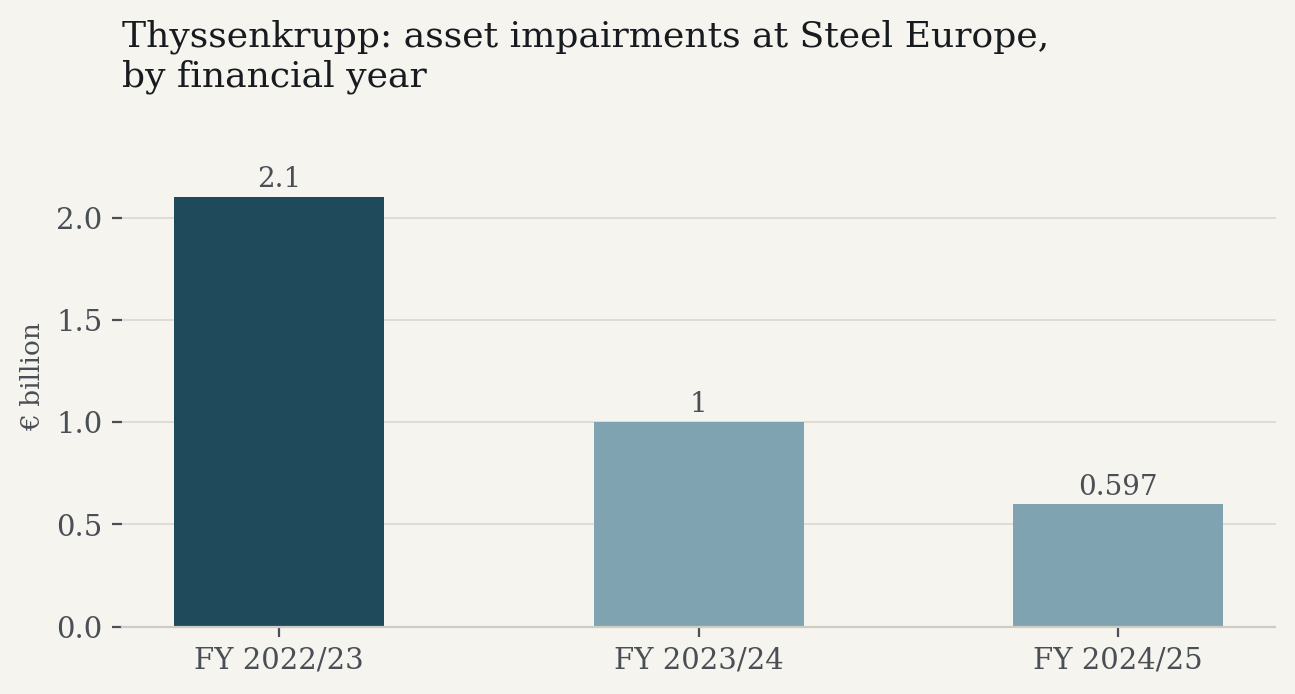
Thyssenkrupp’s European steel division recorded write-downs of around 3,700 million euros over three financial years, charging the investments required for the green transition to the 2023/24 accounts (Thyssenkrupp, 2023; 2024; 2025). That plant was expected to receive around 2,000 million euros in public funding out of the total 3,000 million euros planned, however, its viability is now under review (GMK Center, 2024; Thyssenkrupp, 2025). Meanwhile, ArcelorMittal abandoned similar subsidised projects in Germany and Dunkirk (Eurometal, 2025; GMK Centre, 2025). Public money helped to cover the substantial capital investments budgeted, but was unable to fully offset the impact of the costs.
Conclusion: an expiry date is also an indication
As I have been mentioning, in addition to the war in the Gulf, Ukraine’s attacks on Russian refineries and the French government’s fuel price controls, in this article I have been arguing that there is another party responsible for the supply problems at French petrol stations in recent months. By setting a date for the end of combustion-engine cars and linking that date to an ever-rising carbon price, European policy signalled to the most capital-intensive supplier industries how much longer it would be worthwhile to continue holding onto their assets. Accounting standards translated that message into shorter useful lives and impairment losses.
In my article on the motor industry, I point out that the sector’s failure stemmed from a lack of adaptability, as the industry was shielded from market signals rather than being left openly exposed to them. Similarly, in the refining and steel sectors, the regulator manipulated the signal by setting a specific date, and industries both within and outside the sector complied with it faithfully, withdrawing capacity that the continent still needed and reducing the investment that their plans would have required in the years to come. This is precisely the error that Hayek identified eight decades ago: the belief that an all-knowing central authority can predict, many years in advance, when a technology will cease to be necessary and, consequently, decree that it should be replaced.
Professor J.R. Rallo (2026) is right to argue that prices will eventually rebalance the market, destroying demand and attracting supply from other regions. Unfortunately for consumers, he is also right to point out that the new equilibrium will be at a structurally higher price. Given that diesel is an input at almost every stage of the production process, this means a loss of economic activity and jobs, and consequently higher costs at every stage of the supply chain, and therefore higher consumer prices. With stocks at the Amsterdam–Rotterdam–Antwerp hub at their lowest level since 2021 and low water levels on the Rhine limiting the passage of barges inland, France is, as the Professor suggests, “the canary in the coal mine”. Finally, it is true that the long-term solution would be to reinvest in lost refining capacity; however, in Europe, the major obstacle to such reinvestment is the regulatory framework itself, which has precisely rendered it irrational and unattractive. No investor or corporation will rebuild a refinery for a market where the law has condemned an entire sector to disappear, at least under the conditions we currently face.
Even analysts who had been advocating for faster electrification now acknowledge the problems caused by interventionism. BNP Paribas’s analysis and research department concluded last April that only a proactive industrial policy prioritising economic security (“even at the expense of decarbonisation efforts”) could restore significant refining capacity to Europe (Devaux, 2026). The strategic dialogue launched in October will be judged on whether it broadens the planning horizon for European refineries or whether it simply brings them back under the old, centrally dictated regime.
From my point of view, this situation gives rise to two political and economic implications. Firstly, timeframes must be set on the basis of prices. A credible and technologically neutral price for emission allowances allows the useful life of each asset to be determined by its competitiveness in its respective market, whilst a ban with a fixed end date shortens the useful life of all such assets at once. Secondly, refining capacity and product stocks close to the point of consumption could be treated as security infrastructure, with the same seriousness with which Europe has addressed, albeit belatedly, gas storage.
Meanwhile, the United States has turned Europe’s dependence into a commercial advantage. Having become Europe’s supplier of last resort, with approximately half of its seaborne diesel imports coming from outside the region (Strautmann, 2026), Washington considered imposing export restrictions ahead of the mid-term elections (Katinas, 2026) and, subsequently, used that threat to pressure Germany and France into releasing emergency reserves (Slav, 2026). On 2nd October, the G7 agreed to a coordinated release of up to 100 million barrels, with a greater proportion being diesel (Euronews, 2026a; 2026b), and a week later Washington eased its own sanctions on Russian diesel, a move the EU has refused to follow (Euronews, 2026c). Europe’s emergency reserves now fulfil the role previously played by its closed refineries, and reserves, unlike refineries, run out. A continent that allows its own capacity to fall into disuse inherits the political priorities of whoever supplies it.
In recent years, we have been observing how Europe’s political preference is slowly shifting. The 2024 European elections, the Draghi report and the European Commission’s “Competitiveness Compass” (2025) have shifted the debate from ‘how to regulate’ to ‘how to compete’, and that window of opportunity will not remain open indefinitely. Regulations can be amended more easily than industrial capacity that is shut down, investment that is relocated to other regions, or talent that leaves – factors that are far more difficult and costly to recover. What the region needs now is a coherent framework to rebuild its competitiveness vis-à-vis other economic blocs – one that addresses energy costs, capital markets, the regulatory burden and scale as a single agenda, rather than as separate issues. That framework must be based on fewer, higher-quality regulations, drafted with the active involvement of industry experts who understand how they will work on the ground. Decisions taken without such knowledge often solve one problem whilst creating several others, and the collateral damage falls on the businesses and workers least able to absorb it. Competitiveness is not an end in itself. It is the only sustainable basis for higher wages, robust public services and better living conditions for European citizens, and every year of delay comes at a cost that they will have to bear.
References
ACEA (2026) New car registrations: +1.8% in 2025; battery-electric 17.4% market share, 27 January. Reproduced by AFIA.
AFP (2024) La raffinerie de Donges, 2e de France, entièrement à l'arrêt pour corrosion et fuites, L'info durable, 2 March.
Argus (2024) Viewpoint: European refineries suffer underinvestment, Argus Media, January.
Argus (2025) UK's Grangemouth refinery stops processing crude, Argus Media, April.
Bloomberg (2026) Trump's fuel export ban threat sends European diesel soaring, 23 September. https://www.bloomberg.com/news/articles/2026-09-23/trump-s-fuel-export-ban-threat-sends-european-diesel-soaring
Business Today (2026) French fuel crisis deepens as one in nine stations run out of stock, diesel prices at record high, 20 September. https://www.businesstoday.in/world/story/french-fuel-crisis-deepens-as-one-in-nine-stations-run-out-of-stock-diesel-prices-at-record-high-556664-2026-09-20
Carbon Market Watch (2026) Why some steelmakers are trying to weaken the EU ETS, 6 July. https://carbonmarketwatch.org/2026/07/06/why-some-steelmakers-are-trying-to-weaken-the-eu-ets/
Carra Globe (2026) Strait of Hormuz closure 2026: what it means for your supply chain and shipping routes, July. https://carraglobe.com/strait-of-hormuz-closure-2026/
CNN (2026) Russia bans diesel exports after Ukrainian attacks, straining already tense global market, 9 July. https://www.cnn.com/2026/07/09/business/russia-diesel-ban-ukrainian-strikes-intl
European Commission (2025). Compass for Competitiveness. https://commission.europa.eu/topics/competitiveness/competitiveness-compass_es
CPDP, Comité Professionnel du Pétrole (2026) Le marché pétrolier. https://www.cpdp.org/le-marche-petrolier
Dahl, J. (2026) EU Commission ignored its own advice before weakening car CO2 rules, POLITICO Europe, 28 September.
Devaux, P. (2026) Refined petroleum products: should we be worried about shortages in Europe?, Eco Week, BNP Paribas Economic Research, 7 April. https://economic-research.bnpparibas.com/html/en-US/Refined-petroleum-products-should-worried-about-shortages-Europe-4/7/2026,53342
DieselNet (2025) Wood Mackenzie: more than 20% of global refining capacity at risk of closure, April 2025, https://dieselnet.com/news/2025/04woodmac.php
Dixit, A.K. and Pindyck, R.S. (1994) Investment under Uncertainty. Princeton, NJ: Princeton University Press.
Draghi, M. (2024) The Future of European Competitiveness. Part B: In-depth Analysis and Recommendations. Brussels: European Commission.
Electrive (2026) EU Transport Committee postpones Auto Package vote, 2 October. https://www.electrive.com/2026/10/02/eu-transport-committee-postpones-auto-package-vote/
Enerzine (2026) Pénurie d'essence : 21% des stations à sec en SP95, le plein va-t-il devenir un casse-tête?, 12 September. https://www.enerzine.com/penurie-essence-stations-rupture-carburant/194533-2026-09
EU Perspectives (2026) Refining margins soar while Europe's fuel capacity shrinks, August, summarising S&P Global Energy projections first reported by the Financial Times.
Eurometal (2025) ArcelorMittal cancels DRI-EAF decarbonisation investment in Germany, 23 June. https://eurometal.net/arcelormittal-cancels-dri-eaf-decarbonisation-investment-in-germany
Euronews (2026a) G7 agrees 100 million-barrel emergency oil release amid US pressure over diesel, 2 October. https://www.euronews.com/2026/10/02/g7-agrees-100-million-barrel-emergency-oil-release-amid-us-pressure-over-diesel
Euronews (2026b) Exclusive: G7's 100-million-barrel pledge tied to unfinished March emergency oil release, 8 October. https://www.euronews.com/2026/10/08/exclusive-g7s-100-million-barrel-pledge-tied-to-unfinished-march-emergency-oil-release
Euronews (2026c) EU decries concerning Trump-Putin deal, insists sanctions on Russia will continue, 12 October. https://www.euronews.com/2026/10/12/eu-decries-concerning-trump-putin-deal-insists-sanctions-on-russia-will-continue
Europe 1 (2023) Une raffinerie de TotalEnergies mise en demeure par la préfecture de Loire-Atlantique, December. https://www.europe1.fr/node/5391
European Parliament and European Council (2023a) Regulation (EU) 2023/851 of 19 April 2023 amending Regulation (EU) 2019/631 as regards strengthening the CO₂ emission performance standards for new passenger cars and new light commercial vehicles. Official Journal of the European Union, L 110.
European Parliament and European Council (2023b) Directive (EU) 2023/959 of 10 May 2023 amending Directive 2003/87/EC establishing a system for greenhouse gas emission allowance trading within the Union. Official Journal of the European Union, L 130.
European Parliament and European Council (2023c) Regulation (EU) 2023/956 of 10 May 2023 establishing a carbon border adjustment mechanism. Official Journal of the European Union, L 130.
Fattouh, B. and Economou, A. (2026) Europe's Oil Vulnerability to the Strait of Hormuz Disruption. OIES Energy Comment, April. Oxford: Oxford Institute for Energy Studies. Link.
Fèvre, P. (2026) There Is No European Lee Iacocca. phfevre.com.
FuelsEurope (2026) A Strategic Industrial Asset Europe Cannot Afford to Lose. Brussels: FuelsEurope. https://www.fuelseurope.eu/a-strategic-industry
Geiger, J. (2026) Drone strikes cripple half of Russia's top diesel refineries, OilPrice.com, 15 September, citing Reuters.
GMK Center (2024) Thyssenkrupp: how the company has transformed its steel business over the past 5 years. GMK Center, https://gmk.center/en/news/arcelormittal-confirms-suspension-of-plans-for-dri-plant-in-dunkirk/
GMK Center (2025) 'ArcelorMittal confirms suspension of plans for DRI plant in Dunkirk', 23 July. GMK Center, https://gmk.center/en/news/arcelormittal-confirms-suspension-of-plans-for-dri-plant-in-dunkirk/.
Harrigan, K.R. and Porter, M.E. (1983) End-game strategies for declining industries, Harvard Business Review, 61(4), pp. 111–120.
Harvey, R. (2026) Europe's gasoline exports drop, tightening market during US summer driving season, Reuters, 16 June.
Hayek, F.A. (1945) The use of knowledge in society, American Economic Review, 35(4), pp. 519–530.
ICCT, International Council on Clean Transportation (2016) European Vehicle Market Statistics: Pocketbook 2016/17. Figures as reported by WardsAuto.
IFRS Foundation (2023) Effects of Climate-related Matters on Financial Statements, educational material, reissued July 2023 (first issued November 2020). IFRS.
IFRS Foundation (2025), IAS 8 Accounting Policies, Changes in Accounting Estimates and Errors; IAS 16 Property, Plant and Equipment, paras. 14, 51 and 56; IAS 36 Impairment of Assets, para. 12. London: IFRS Foundation.
International Council for Clean Transport (2025) Proposal to weaken CO₂ standards could delay EV progress in Europe, December. https://theicct.org/proposal-to-weaken-co2-standards-could-delay-ev-progress-in-europe/
International Energy Agency (2026) Russian refining sector struggles amid intensifying Ukrainian attacks, commentary, September. https://www.iea.org/commentaries/russian-refining-sector-struggles-amid-intensifying-ukrainian-attacks
IRU (2026) Diesel prices surpass previous 2026 records, September. IRU.org, https://www.iru.org/news-resources/newsroom/diesel-prices-surpass-previous-2026-records
Katinas, P. (2026) Europe's diesel vulnerability to US export restrictions, RUSI Commentary, 25 September. https://www.rusi.org/explore-our-research/publications/commentary/europes-diesel-vulnerability-us-export-restrictions
Kilian, L., & Zhou, X. (2023). A broader perspective on the inflationary effects of energy price shocks. Energy Economics, 125, 106893.
Kornai, J. (1980) Economics of Shortage. Amsterdam: North-Holland.
Kornai, J. (1986) The soft budget constraint, Kyklos, 39(1), pp. 3–30.
Kornai, J., Maskin, E. and Roland, G. (2003) Understanding the soft budget constraint, Journal of Economic Literature, 41(4), pp. 1095–1136.
Kydland, F.E. and Prescott, E.C. (1977) Rules rather than discretion: the inconsistency of optimal plans, Journal of Political Economy, 85(3), pp. 473–491.
L'Automobiliste (2026) Carburant: 17% des stations sont en pénurie, annonce Bercy, 21 September. https://lautomobiliste.fr/21/09/2026/carburant-17-stations-penurie-bercy/
L'EnerGeek (2026) Carburant: 17% des stations manquent d'au moins un carburant, 21 September. https://lenergeek.com/2026/09/21/carburant-17-stations-manquent-moins/
Ministère de la Transition Écologique (2018) La chaîne pétrolière: le raffinage en France. Gouverment de France. https://www.ecologie.gouv.fr/politiques-publiques/chaine-petroliere
Motor1 (2023) TotalEnergies va plafonner le carburant à 1,99€ toute l'année, February. https://fr.motor1.com/news/653965/totalenergies-plafond-1-99-2023/
Norways, K. (2024) Europe's refining sector braces for major downsizing as margins stall, S&P Global Commodity Insights, 18 July.
Oxford Institute for Energy Studies (2026) Modelling the Impact of the Strait of Hormuz Closure on Global Gas Flows and Prices. OIES Energy Comment, March.
Pacheco, M. (2026) Von der Leyen turns to Europe's refineries as shrinking capacity raises energy security concerns, Euronews, 6 October. https://www.euronews.com/2026/10/06/von-der-leyen-turns-to-europes-refineries-as-shrinking-capacity-raises-energy-security-con
Petro Online (2026) UK refining capacity falls to four plants after a second unplanned closure. Petro Online, https://www.petro-online.com/news/fuel-for-thought/13/international-environmental-technology/uk-refining-capacity-falls-four-plants-second-unplanned-closure/68046
Rallo, J.R. (2026) Francia se queda sin diésel: ¿está Europa en riesgo? [video], YouTube, 20 September. https://youtu.be/9z9mgym4txA
Reuters (2023) France: Bruno Le Maire demande à TotalEnergies de prolonger le plafonnement du prix du carburant, 7 September, via Boursorama. https://www.boursorama.com/bourse/actualites/france-bruno-le-maire-demande-a-totalenergies-de-prolonger-le-plafonnement-du-prix-du-carburant-63e2f54e3400709d3ce24e54149a652d
Reuters (2025) More European oil refineries to close, convert in next 10 years, panel says, 24 March, via MarketScreener. https://www.marketscreener.com/quote/index/S-P-GSCI-BIO-FUEL-INDEX-46869729/news/More-European-oil-refineries-to-close-convert-in-next-10-years-panel-says-49417063/
Roole (2026) Pénurie de carburant: risquez-vous vraiment de ne pas trouver d'essence à la pompe?, September. Roole Media. https://media.roole.fr/quotidien/au-volant/penurie-de-carburant-risquez-vous-vraiment-de-ne-pas-trouver-dessence-a-la-pompe
S&P Global Commodity Insights (2025a) Refinery news roundup: change of ownership in focus in Europe, 11 February. S&P Global.
S&P Global Commodity Insights (2025b) Study on the Potential Evolution of Refining and Liquids Fuel Production in Europe, prepared for Concawe, February.
S&P Global Commodity Insights (2025c) Survival of the fittest: European refiners jostle to outlast closures, 25 March. S&P Global.
Shell plc (2020) Impairments, second quarter 2020, filed with the US SEC.
Skenta (2026) Pénurie carburant: 1 station sur 6 en rupture, 10 October. https://www.skenta.app/actualites/ruptures-carburant-stations-septembre-2026
Slav, I. (2026) Europe's diesel woes just got even worse, OilPrice.com, 5 October. https://oilprice.com/Energy/Crude-Oil/Europes-Diesel-Woes-Just-Got-Even-Worse.html
SteelOrbis (2026a) EUROFER: no improvement in apparent steel consumption expected before Q1 2026. Steel News, Interviews. January. https://www.steelorbis.com/steel-news/interviews/eurofer-no-improvement-in-apparent-steel-consumption-expected-before-q1-2026-1431477.htm
SteelOrbis (2026b) EUROFER: EU automotive sector to remain weak in 2026, steel tube output to grow slightly, Steel News, June. https://www.steelorbis.com/steel-news/latest-news/eurofer-eu-automotive-sector-to-remain-weak-in-2026-steel-tube-output-to-grow-slightly-1461827.htm
StoneX (2025) Europe's refining crunch fuels diesel market stress, 20 November. https://www.stonex.com/en-gb/insights/europe-s-refining-crunch-fuels-diesel-market-stress
Straits.live (2026) Strait of Hormuz status: 13 October 2026, daily brief citing IMF PortWatch transit data.
Strautmann, M. (2026) Europe's diesel options narrow, Vortexa, August. https://www.vortexa.com/insights/europes-diesel-options-narrow
ThyssenKrupp (2023) ThyssenKrupp held its ground in a challenging environment: fiscal year 2022/2023, press release, November.
ThyssenKrupp (2024) thyssenkrupp held its ground in a difficult market environment: fiscal year 2023/2024, press release, November.
ThyssenKrupp (2025) Annual Report 2024/2025. Essen: ThyssenKrupp AG.
ThyssenKrupp Steel (2012) ThyssenKrupp Steel Europe puts blast furnace 9 in Duisburg back into operation, ThyssenKrupp, press release.
UFIP Énergies et Mobilités (2025) Chiffres clés 2024, News Tank Energies. https://energies.newstank.fr/article/view/435246/france-57-mt-capacite-raffinage-2024-28-gazole-importe-moyen-orient-ufip.html
U.S. Energy Information Administration (2025) Summer diesel margins tighten with European supply shift, Today in Energy, 17 September. https://www.eia.gov/todayinenergy/detail.php
van Gaal, W. (2025) Draghi comes out against EU's 2035 combustion engine ban, EUobserver, 16 September.
VisualEconomik (2026) La prohibición del diésel de Trump dejaría a medio mundo sin combustible [video], YouTube, September. https://youtu.be/MzCGwnKNVxU
Wood Mackenzie (2024) Global refinery capacity totalling 3.6 million b/d at high-risk of closure, Wood Mackenzie, press release, 28 March. https://www.woodmac.com/press-releases/global-refinery-capacity-totalling-3.6-million-bd-at-high-risk-of-closure
Woodward, A. (2026) France runs short of diesel as Europe faces fuel supply warning, Euro Weekly News, 22 September. https://euroweeklynews.com/2026/09/22/france-runs-short-of-diesel-as-europe-faces-fuel-supply-warning
Philippe Fèvre (plfevre@comillas.edu) earned his DBA cum laude from Universidad Pontificia Comillas. He holds postgraduate qualifications from Chicago Booth, IE Business School, MIT as well as Universidad Pontificia Comillas. A senior executive and strategic advisor with over 25 years of international experience. His academic research interests include SME leadership, disruptive entrepreneurship, and digital transformation.