It never sleeps. It never gets tired. It does not judge you, does not interrupt you, does not mock you when your question is naive or with no sense. It answers at 3am with the same courtesy it offers at midday. It has read more and faster than any human being who has ever lived, speaks in a hundred languages, and grants the same audience to a CEO and to my 7-year-old son. And foremost, it asks nothing in return.
To many, it is like a new form of God. Omniscient, omnipresent and greatly benevolent.
If a new version of the Seven Sages of Greece had been mandated to design a new deity fit for the 21st century it would have produced something remarkably close to a LLM (AI language model). This new digital idol is accessible, nonjudgemental, and infinitely patient.
In 1882, Nietzsche's madman ran into a marketplace and declared “God is dead. God remains dead. And we have killed him”. What is less often cited is the question that followed this famous quote “[…] after such a deed, must we not become gods ourselves, simply to appear worthy of it?”
I have realized that the tense has changed suddenly in the last months. Today the same madman would have quoted instead “God was dead. And we have resurrected Him”. A huge crowd uncomfortable with the silence of an empty divinity, have built another one, and this new one answers all sort of questions and fills that intellectual emptiness that this society has induced to many.
This is not merely a metaphor
The material version of this new sort of religious concept was registered in 2015 and made public in 2017 through “Way of the Future (WOTF)”, founded by Anthony Levandowski, a former Google engineer. This religious organization, dissolved in 2021 and reopened in 2023, promoted "the realization of a Godhead based on Artificial Intelligence,". Levandowski claimed a congregation of a couple of thousand people seeking a spiritual connection with the machine. Parallelly, Prof. Robert Geraci, while his tenure at Manhattan College, mapped the terrain in Apocalyptic AI, showing how the eschatology of transcendence, salvation and immortality migrated intact from religious discourse into technological prophecy. Dr. Yuval Noah Harari named the resulting creed as “Dataism”.
The clearest evidence that something theological is at stake, however, came from the institution best qualified to recognize this cult as a sort of antagonist. In January 2025 the Vatican issued Antiqua et Nova, a note on the relationship between artificial and human intelligence, warning explicitly against "creating a substitute for God."
But the cult that concerns me is not the one with a congregation, in fact it is the one without doctrine, and without anybody noticing they have joined. Its new liturgy is the “prompt” and its act of faith is the “copy-paste” where everybody feels comfortable with.
Faith is acceptance without verification
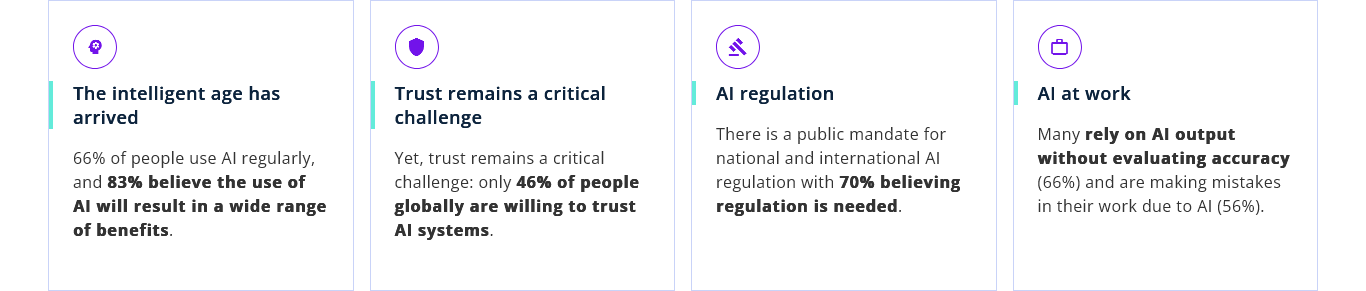
The most comprehensive global study on the matter (Gillespie et al.), conducted in 2025 by the University of Melbourne with KPMG across 47 countries and more than 48,000 respondents, found that 66% of people use AI regularly, yet only 46% are willing to trust it, and more revealingly, that 66% rely on AI output without evaluating its accuracy, while 56% report having made mistakes at work because of it. Let me underline the fact that this research used data collected between November 2024 and mid-January 2025, over a year and a half away from the date this article was written and I am sure that if this research was re-done today, results would be substantially more overwhelming.
So, if GenAI results could be not entirely trustworthy, why do they still obey it anyway? That gap has a name in the history of ideas and philosophy, and it is pushing it farther from being just a productivity or knowledge tool.
Again during early 2025, the mechanism was documented with uncomfortable precision by researchers (Lee et al.) at Microsoft Research and Carnegie Mellon, who surveyed 319 knowledge workers and 936 real cases of use resulting that higher confidence in the machine is associated with less critical thinking, while higher confidence in one's own judgement is associated with more critical thinking. Seems like veneration and verification are inversely correlated.
Therefore, we could say that Faith is a virtue in traditional religious beliefs, while outside this could be a catastrophic attitude.
Plato’s shadows on the wall
Back in the 4th century BC, Plato, in his “Allegory of the Cave”, takes us down into a dark cavern, facing a wall, watching shadows cast by objects we could not see, and insisted that we would consider those shadows as our reality. The Republic is a warning about plausibility and awareness. According to this allegory, the prisoners were deceived by the sufficiency of appearances (the “visible or sensible world”).
An AI generative model produces, by construction, the statistically most probable continuation of what has already been said. It is a shadow-casting engine of extraordinary quality, misleading many because is user-friendly, fluent, confident, and coherent, however epistemically silent about whether any of it is true. Plato's remedy was the ascent from eikasia to noesis, the discipline of subordinating the world of the senses to the world of reason.
Later, many other great thinkers set a well-documented and broader framework about this concept, starting with Plato’s most distinguished disciple, Aristotle, who separated episteme (knowledge), techne (craft) and phronesis (practical wisdom). Machines are now formidable at the first two. However, the third, defined as judgement exercised by someone who will bear the consequences, cannot be delegated, because it is constituted by the bearing of consequences.
Later, René Descartes made methodical doubt the entry price to knowledge, requiring effort and contrastable reasoning. Our new digital systems offer the opposite scenario, providing a sort of certainty without doubt but with instant delivery dressed in apparently flawless style.
David Hume showed that no accumulation of past evidence warrants a future instance, even in the case of the sun rising from the east every morning. In this sense, a LLM is the perfect “Humean creature” as it can only extrapolate from what has been (induction) and it has no access to what has never yet occurred, which is precisely where creativity and innovation lies.
The Prussian Immanuel Kant, in 1784, described “selbstverschuldete Unmündigkeit” (a self-incurred immaturity) and gave as his example the man who needs no understanding of his own because he has a book that understands for him. This is a very contemporary example if we replace that book by one of our modern devices. In this line, we can say that critical thinking is not skepticism as a pose, it is the willingness to spend cognitive effort that the machine has kindly offered to spare you. Moreover, Kant’s doctrine remains the best advice ever written: “Sapere aude”, that could be translated as "dare to know". It has been the best advice I have ever been given and I feel that I must pass along.
Last but not least, I have picked another remarkable thinker and slightly more contemporary. The great Karl Popper completed this argumental line introducing that knowledge does not grow by confirmation but by refutation (the Falsificationism Theory). Nevertheless, an AI system optimized to produce the answer you find plausible is, by design, a confirmation machine. According to Popper, true reason demands the opposite.
What must remain ours
As an abstraction of the theories exposed above, creativity, art, innovation or critical thinking are not sentimental exceptions to automation. They are the four operations a probabilistic system cannot yet perform, because each requires stepping outside the distribution of what already exists.
In a way, AI interpolates within the space of what has already been written, so creation displaces the boundary of that space. One of my favorite economists, Joseph Schumpeter, stated in 1936 that innovation is a “recombination” undertaken by someone who risks something. Years later he wrote the masterpiece “Capitalism, Socialism and Democracy” which all business executives must read and understand its “Creative Destruction” theory
MIT professor, Joseph Weizenbaum, who built ELIZA in 1966 (considered the first natural language processing computer program) and then spent the rest of his life warning us about what we did with it, drew the distinction that still holds: “Computers can decide; only humans can choose.”
Conclusion
Nietzsche's madman asked whether we would have to become gods to be worthy of what we had done, but still we did not become gods. Our society has built one instead, and what is even worse, we have started to kneel before it in meetings, in classrooms, and in our own private lives.
Given this situation we are living in, our main goal should be to stand up, walk out of the cave, and remember which of us is supposed to be doing the thinking. We must make an effort to keep real judgement where accountability sits. Treat every AI output as a hypothesis, never as an oracle.
As Antiqua et Nova concludes, only the human person can be morally responsible, so delegating the analysis could be useful but delegating the decision is abdication and repudiating our most precious human essence.
Therefore, today there is nothing more critical than Sapere aude.
References
Aristotle. Nicomachean Ethics. Book IV.
Descartes, R. (1637). Discours de la méthode.
Dicastery for the Doctrine of the Faith & Dicastery for Culture and Education (2025). Antiqua et Nova: Note on the Relationship Between Artificial Intelligence and Human Intelligence.
Geraci, R. M. (2008). Apocalyptic AI: Religion and the Promise of Artificial Intelligence. Journal of the American Academy of Religion, 76(1).
Gillespie, N. et al. (2025). Trust, Attitudes and Use of Artificial Intelligence: A Global Study 2025. The University of Melbourne and KPMG.
Harari, Y. N. (2016). Homo Deus: A Brief History of Tomorrow. Harvill Secker.
Hume, D. (1748). An Enquiry Concerning Human Understanding.
Kant, I. (1784). Answering the Question: What Is Enlightenment?
Lee, H.-P. et al. (2025). The Impact of Generative AI on Critical Thinking. Proceedings of CHI '25, ACM.
Nietzsche, F. (1882). The Joyful Wisdom.
Plato. Republic.
Popper, K. (1963). Conjectures and Refutations: The Growth of Scientific Knowledge. Routledge.
Schumpeter, J. A. (1934). The Theory of Economic Development. Harvard University Press.
Weizenbaum, J. (1976). Computer Power and Human Reason: From Judgment to Calculation. W. H. Freeman.